Hello at the beginning of Maundy Thursday and the days that follow.
This is Anglican DOWN UNDER so I do quite a bit of trawling across our main print media news sites, Stuff and NZ Herald (and sometimes Sydney Morning Herald).
This morning I noticed the name of my friend and New Testament studies colleague, Derek Tovey. He has written an article on the historicity of Jesus' crucifixion for the NZ Herald.
Then my news trawling, which includes Twitter, noticed this article on a woman called Marielle Franco. I had never heard of her but she was a Brazilian politician who was assassinated after challenging the power structures of her country.
Her story is an analogue for the crucifixion of the historical Jesus: whatever divine purposes were being worked out through the death of Jesus (destruction of power of evil; propitiation and expiation of sin and guilt), there was an historical explanation for his death, as Derek Tovey's article explains. Jesus, a political nobody, threatened the cosy power sharing arrangements in Palestine, and needed disposing of, before things got out of hand.
Bonus link:
with H/T to a correspondent, here is an interview with Ross Douthat who has written a book on Pope Francis.
Bonus bonus links:
I have noticed this article on four options for evangelical Christians, responding to the cutlure of today in the West.
Also, because I want to mark the article even though I am going to ban discussion of it (for the Usual Reasons about That Topic), Ian Paul has posted an erudite, careful discussion of a case in the UK which raises some questions for ACANZP as it discusses the Motion 29 proposal.
Happy reading or viewing over the Easter break ...
Thursday, March 29, 2018


Wednesday, March 28, 2018
Substitutional sacrifice
We may have read the news story this week of a French police officer, Arnaud Beltrame, who swapped himself for one of the hostages taken by an extreme Islamist gunman only to die of his injuries when the gunman shot him as armed forces moved on the hostage taker.
What you may or may not have read - because it is being ignored by some news outlets - is that the heroic officer was a committed Catholic Christian.
He gave himself that another might live.
Like Jesus, he sacrificially substituted himself for the sake of another.
What you may or may not have read - because it is being ignored by some news outlets - is that the heroic officer was a committed Catholic Christian.
He gave himself that another might live.
Like Jesus, he sacrificially substituted himself for the sake of another.
Tuesday, March 27, 2018
I agree: cut down on the number of miracles needed for sainthood
Fr Maurice Carmody is a scholar and a gentleman whom I got to know when he was parish priest of St Francis' Catholic Church, Stoke, Nelson. He has doggedly pursued the NZ Catholic Church's ambition to have NZ's first saint made, the famous Mother Suzanne Albert. His scholarly researches into the matter have left no stone unturned, and there have been many trips to Rome to press the case. But he has hit a snag, as this report tells us: the Vatican quota of two miracles is too high.
I agree that the quota is too high. There should be no requirement for any miracles to be associated with a person being made a saint. None were required in New Testament times. In fact Paul addressed the whole church as saints of God (Ephesians 1:1), with no mention of evidential miracles. The implication is, of course, that the one and only necessary miracle for someone to become a saint is the miracle of salvation.
I agree that the quota is too high. There should be no requirement for any miracles to be associated with a person being made a saint. None were required in New Testament times. In fact Paul addressed the whole church as saints of God (Ephesians 1:1), with no mention of evidential miracles. The implication is, of course, that the one and only necessary miracle for someone to become a saint is the miracle of salvation.
Monday, March 26, 2018
A weekend away
One of the best periods of my life - in which, praise God, there have been many good periods - were the years 1984-86.
I was in Dunedin for theological study at Knox Theological Hall (a Presbyterian seminary at which "private students" of the University of Otago, such as my Anglican self, also studied). I am thankful to this day for the outstanding quality of the teaching, the pastoral care and scholarly attentiveness of the teachers and the brilliance of the ethos. In hindsight, it was a wonderful era for Presbyterian ministers in training (a number of whom I have met up with in recent years) and it was near the end of an aeon. By the 1990s all teaching of B.Theol. and B.D. subjects took place at the University itself.
I lived at Selwyn College - an Anglican residential college of the University. Selwyn College then and now has had a mixed reputation: some brilliant and famous alumni have emerged from the College. But around Otago University, any story of heavy drinking fuelling outrageous behaviour, daring pranks and strenuous initiation rites is bound to bring "Selwyn" instantly to mind. Even if it turns out it was students from Arana ... :)
I worshipped at St Matthew's Church, Hope St - an inner city Anglican parish with a reputation as a leading student church. John Meadowcroft was the Vicar and he was an outstanding Bible teacher and leading charismatic. (It is another blogpost for another day to speak about some of the experiences of that charismatic era.)
Selwyn College was founded in 1893 and named after the first and only Bishop of New Zealand, George Selwyn. Is there any other Anglican bishop of the 19th or 20th centuries who has had two university colleges named after him? The other is at Cambridge University.
So this year is the 125th anniversary of that founding and this weekend past was the celebratory weekend. Teresa and I were able to travel down from Christchurch in a leisurely way on Friday. En route we stopped off at Karitane (about 30 minutes north of Dunedin). Its bays are exquisite. World class.

On the way back, yesterday, we journeyed via Aramoana at the northern end of Otago Harbour, then turned at Port Chalmers for a winding route to SH 1 back to Christchurch. This view, from a lookout above Port Chalmers, across the harbour to Portobello, is as good as they come, anywhere in the world.

Within 30 minutes of the centre of Dunedin such brilliant scenes as captured in the two photos above could be multiplied a dozen times. It is the most extraordinary region geographically and scenically speaking. It also has some tough weather. Let's just say it is not tropical there so the vast population of Auckland lives in Auckland rather than in Dunedin. But if Dunedin were closer to Auckland, it would be our largest city and Auckland just a port with some factories around the mudflats!
Back to the weekend. We had a great time with a welcome event on Friday night, photos Saturday morning, a cricket match in the afternoon, a fab dinner on Saturday night, then the opening of a new building ("Fitchett House" - a redolent Anglican name, as some readers here will recognise) on Sunday morning before gathering outside Selwyn's entrance for the beginning of our Palm Sunday church service.

In the pic are Archbishop Philip Richardson (our NZ Dioceses' Primate, former Warden and former student of Selwyn College), Bishop Stephen Benford (new-ish Bishop of Dunedin) and Fr Michael Wallace (Vicar of All Saints, Dunedin - the church which forms part of the Selwyn courtyard). We processed from the entrance to Selwyn around the block to All Saints church itself. ++Philip preached and +Stephen presided at our eucharist.
Archbishop Philip challenged us on Sunday morning to prove to him that there is one person God doesn't love. His point being that everyone of us - each of us utterly unique and different from the other - is loved by God. Without exception. On Saturday night, Bill English, former PM, spoke about his experiences of Selwyn College and what it had contributed to his life. He could not remember why, as a staunch Catholic he and his siblings ended up residents at Selwyn College, but it cannot have done them any harm because they have sent their children there.
Among several speakers on Friday night we heard from David Kirk, former All Black captain and current business leader based in Australia. He paid tribute to Selwyn as a place of transition from the cocoon of home to the independence of adulthood.
Nevertheless the lived experience of Selwyn was not far away in what was said by a range of speakers. In that actual history of the college, alcohol has been mixed many times with the "stupidity of youth" (a phrase used in Bill English's address), with predictable results. There was a lot of drinking when I was there. I imagine there is less these days. I think students are more serious about meeting assignment deadlines than we were.
What remains a challenge for the College is what Archbishop Philip addressed in his sermon yesterday morning: how to give expression to the love of God in a community of young people bound together for a relatively short period of time. A starting point is that Selwyn has always been strong on being a community. I can recall lots of alcohol drinking in 1984-86 but we also had supper together, in small groups, Monday to Thursday evenings. Coffee or tea. And biscuits.
Where there is tea and biscuits, there is the love of God!
I was in Dunedin for theological study at Knox Theological Hall (a Presbyterian seminary at which "private students" of the University of Otago, such as my Anglican self, also studied). I am thankful to this day for the outstanding quality of the teaching, the pastoral care and scholarly attentiveness of the teachers and the brilliance of the ethos. In hindsight, it was a wonderful era for Presbyterian ministers in training (a number of whom I have met up with in recent years) and it was near the end of an aeon. By the 1990s all teaching of B.Theol. and B.D. subjects took place at the University itself.
I lived at Selwyn College - an Anglican residential college of the University. Selwyn College then and now has had a mixed reputation: some brilliant and famous alumni have emerged from the College. But around Otago University, any story of heavy drinking fuelling outrageous behaviour, daring pranks and strenuous initiation rites is bound to bring "Selwyn" instantly to mind. Even if it turns out it was students from Arana ... :)
I worshipped at St Matthew's Church, Hope St - an inner city Anglican parish with a reputation as a leading student church. John Meadowcroft was the Vicar and he was an outstanding Bible teacher and leading charismatic. (It is another blogpost for another day to speak about some of the experiences of that charismatic era.)
Selwyn College was founded in 1893 and named after the first and only Bishop of New Zealand, George Selwyn. Is there any other Anglican bishop of the 19th or 20th centuries who has had two university colleges named after him? The other is at Cambridge University.
So this year is the 125th anniversary of that founding and this weekend past was the celebratory weekend. Teresa and I were able to travel down from Christchurch in a leisurely way on Friday. En route we stopped off at Karitane (about 30 minutes north of Dunedin). Its bays are exquisite. World class.

On the way back, yesterday, we journeyed via Aramoana at the northern end of Otago Harbour, then turned at Port Chalmers for a winding route to SH 1 back to Christchurch. This view, from a lookout above Port Chalmers, across the harbour to Portobello, is as good as they come, anywhere in the world.
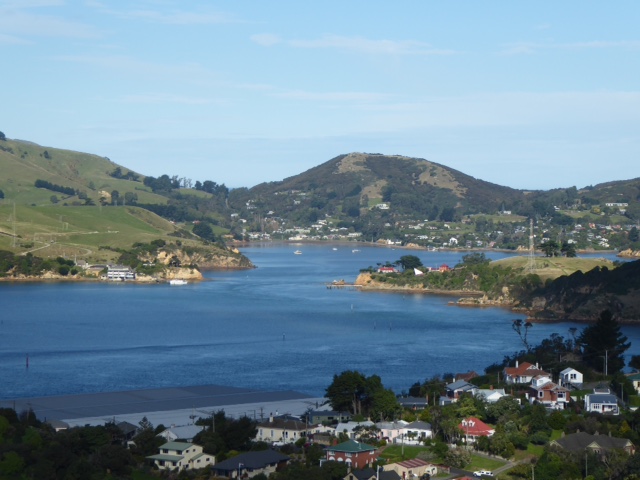
Within 30 minutes of the centre of Dunedin such brilliant scenes as captured in the two photos above could be multiplied a dozen times. It is the most extraordinary region geographically and scenically speaking. It also has some tough weather. Let's just say it is not tropical there so the vast population of Auckland lives in Auckland rather than in Dunedin. But if Dunedin were closer to Auckland, it would be our largest city and Auckland just a port with some factories around the mudflats!
Back to the weekend. We had a great time with a welcome event on Friday night, photos Saturday morning, a cricket match in the afternoon, a fab dinner on Saturday night, then the opening of a new building ("Fitchett House" - a redolent Anglican name, as some readers here will recognise) on Sunday morning before gathering outside Selwyn's entrance for the beginning of our Palm Sunday church service.

In the pic are Archbishop Philip Richardson (our NZ Dioceses' Primate, former Warden and former student of Selwyn College), Bishop Stephen Benford (new-ish Bishop of Dunedin) and Fr Michael Wallace (Vicar of All Saints, Dunedin - the church which forms part of the Selwyn courtyard). We processed from the entrance to Selwyn around the block to All Saints church itself. ++Philip preached and +Stephen presided at our eucharist.
Archbishop Philip challenged us on Sunday morning to prove to him that there is one person God doesn't love. His point being that everyone of us - each of us utterly unique and different from the other - is loved by God. Without exception. On Saturday night, Bill English, former PM, spoke about his experiences of Selwyn College and what it had contributed to his life. He could not remember why, as a staunch Catholic he and his siblings ended up residents at Selwyn College, but it cannot have done them any harm because they have sent their children there.
Among several speakers on Friday night we heard from David Kirk, former All Black captain and current business leader based in Australia. He paid tribute to Selwyn as a place of transition from the cocoon of home to the independence of adulthood.
Nevertheless the lived experience of Selwyn was not far away in what was said by a range of speakers. In that actual history of the college, alcohol has been mixed many times with the "stupidity of youth" (a phrase used in Bill English's address), with predictable results. There was a lot of drinking when I was there. I imagine there is less these days. I think students are more serious about meeting assignment deadlines than we were.
What remains a challenge for the College is what Archbishop Philip addressed in his sermon yesterday morning: how to give expression to the love of God in a community of young people bound together for a relatively short period of time. A starting point is that Selwyn has always been strong on being a community. I can recall lots of alcohol drinking in 1984-86 but we also had supper together, in small groups, Monday to Thursday evenings. Coffee or tea. And biscuits.
Where there is tea and biscuits, there is the love of God!
Wednesday, March 21, 2018
Nelson's Vote on Motion 29 Final Report
Recently here I reported on the Christchurch Diocesan synod's decision on 3 March 2018 to support General Synod adopting the Motion 29 Report and its recommendations.
A week later the Nelson Diocese held a synod on the same matter. So far I have not seen a substantive public report on the decision, including the details of the motion agreed to. Nothing to date in secular media such as the Nelson Mail, nor in our Anglican Taonga, nor on the Diocese of Nelson website.
The only public note I am aware of is this Tweet by Trevor Morrison:
Nelson has voted to support Motion 29. Closer margins than Christchurch. @Liturgy @petercarrell— Trevor Morrison (@TrevsDev) March 10, 2018
I have received other messages. On the one hand I am loathe to become an originator of news. On the other hand the Nelson decision is interesting on a few counts. Working from two published messages of vicars to their parishes (only one of which is on the web, here), I observe the following:
- the part of (a three part) motion to support the recommendations of the Motion 29 Report was supported by roughly 60% of the synod (pretty much the same as the Diocese of Christchurch, but the clergy vote was higher than here and the laity vote lower than here);
- another part of the motion was a unanimous vote making clear that same-sex blessings will not be permitted within the Diocese of Nelson. (For those who know little or nothing about the Diocese of Nelson, this is unsurprising.)
- the third part of the motion concerned thanking the Working Group for their work etc.
- there was concern within the Synod discussion that if the Motion 29 Recommendations do not pass then Motion 30 (from the 2014 Synod, which "lies on the table" currently) would be put forward again. Since Motion 30 is a change to the formularies of our church (i.e. explicit, formal change to doctrine), it is unacceptable to conservative evangelicals (including me).
- thus, by implication, it seems that some votes for supporting Motion 29's recommendations being adopted were pragmatically for the better of two options.
- by contrast, the Motion 30 v Motion 29 issue figured little (as I recall) in our Synod.
My final observation:
I suggest Motion 29, in its substance, will be agreed to by General Synod. In the two Synods where, conceivably, it might have been turned down, it has not. I am not aware of other Pakeha dioceses having Synods specifically about this matter but I have no reason to think that the other Dioceses are not also supportive.
A critical question, however, will be what details we will agree to since GS is capable of amending any and all of the recommendations.
Tuesday, March 20, 2018
Change
Yesterday morning we had a special staff meeting at the Anglican Centre (where I work). At that meeting Bishop Victoria announced that she is resigning from her position as Bishop of Christchurch, effective from 1 May 2018.
Later, at 4 pm, this announcement became public. You can read it here. Bosco Peters has published a note about this and offers other links to relevant information. I join with his call for prayer for +Victoria as she discerns God's next step for her life and ministry, and for the Diocese as we make our next steps.
I have worked for and with +Victoria since 21 January 2010 - just over eight years, most of which have been dominated by our earthquakes and their aftermath. In that time we have had three different locations for the Anglican Centre and five different locations for Theology House. This last 16 months we have been in a common location and it is by far the best of the locations to work in. Bishop Victoria will leave her role with many things settled which were previously unsettled.
Through everything +Victoria has been utterly faithful to God and energetically determined that the God of Jesus Christ is at the front and centre of all we do.
Now we enter a period of change. I know we who live and work within the Diocese will be praying for God's help and for God's will to be done. If you are reading this outside our Diocese please pray for us.
Monday, March 19, 2018
Time for Love - NZ documentary - you may find your friends speaking on it!
I urge Kiwi readers, in particular, to take 48 minutes of precious time, with coffee, tea, wine and/or chocolates at hand to watch the documentary Time for Love.
This is a video, as I understand it, put together by the Auckland Rainbow Community Church in order to offer a viewpoint on the Bible and homosexuality before General Synod in May.
Most of those speaking on the video are friends of mine (and colleagues in the world of biblical and theological studies here). One or two are saying things explicitly I had not heard them say previously.
Perhaps particularly significant are the voices testifying to changing their minds, and the reasons they give for doing so.
I am urging that you watch this video for three reasons, none of which are about urging you to change your minds:
i. We have so little of this quality of biblical and theological presentation made in NZ that we should see what we can produce. (By "quality" I mean that it offers careful, considered thinking about why we might read the Bible in a non-traditional way. The voices include voices of some of our leading biblical and theological scholars.)
ii. Whether we change our minds or not on the matter of homosexuality, whatever we hold to with integrity will have greater integrity if it engages with the exegetical and hermeneutical insights brought forward here.
iii. I am not in it. You do not have to put up with me speaking :)
COMMENTS ARE CLOSED.
As previously, I am not going to accept comments on this matter.
As moderator I continue to need a holiday from moderating this particular debate.
There will be an opportunity in April, before General Synod in early May, to have such a thread of comments. I will re-link to the documentary then.
Subscribe to:
Posts (Atom)