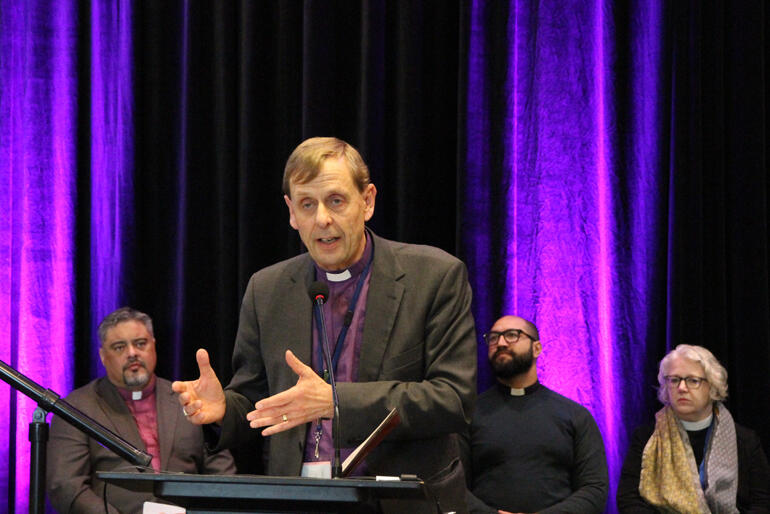
Whether Lambeth 2022 was a failure or a success, on some definition of each, may or may not matter in the great scheme of God's plan for the unity of all things (Ephesian 1:9-10), but I am interested in the "lesser scheme" of God's work within that part of the Christian world described as "Anglican", and the contribution Lambeth 2022 may be judged - short, medium or long term - to have made to that work.
Thus in recent days my eyes have alighted on the following articles, some of which have only appeared in the past week.
+George Sumner (TEC), writing back in August 2022, offers a nuanced, hopeful, Global South-oriented view of the Communion's future, and looks forward to Lambeth 2032.
Andrew Goddard (England), writing as recently as 9 November 2022, offers a significant, detailed critique of what was said at Lambeth 2022, principally by ++Welby, in relation to matters of dispute and decision-making for the Communion as a body variously filled with provincial autonomies and interdependence aspirations. He concludes, in the end, somewhat bleakly:
"Elements of the Archbishop’s contributions, particularly in his final address, give hope for some degree of continuity with the Communion’s historic self-understanding and vision. Other elements, however, raise a number of serious questions and concerns particularly concerning autonomy and subsidiarity. These apparently represent a major break with the received account of these key concepts. This then results in drawing dangerous implications for ordering the Communion’s life. If these features are embraced as the fruit of the Conference’s “intense ecclesiological development” or simply allowed to stand by default (rather than being subject to further scrutiny and refinement, such as that implicit in the Global South’s communiqué) then sadly Ephraim Radner will be proved right and we have just witnessed, despite all the good it has accomplished relationally, “The Last Lambeth Conference.”"
So, what did Ephraim Radner (Canada) make of Lambeth 2022 in the article Goddard references? Writing in First Things in October this year, Radner opens with this paragraph:
"July’s was probably the last recognizable assembly of the Lambeth Conference we shall see in this generation (and perhaps the next). No longer will “all” the bishops of the Anglican Communion gather, but only some, and only from some places. No longer will the deliberation of the Communion’s bishops give rise to common teaching on matters of doctrine and morals. No longer will Anglicans around the world see themselves as engaged in a common evangelical mission."
His analysis of the situation, borne along by his resolute view that the threads which we hold in common are devoid of any substantial common agreements, leads to this - frankly bizarre - estimation of the Communion's common theology and mission:
"To judge by the words of its most public leaders, the Anglican Communion has come to represent a progressive version of the works of mercy: addressing injustice, fighting corruption, combating climate change. The time has come to admit that works of mercy provide the only framework for the current Anglican vocation."
On the other hand, there is the Lambeth 2022 conference I actually attended which highlighted our common commitment to discipleship - to following Jesus as the giver of divine life and embodiment of divine love.
Back to Radner: his final paragraphs about the future of the Communion could be summed up by the word "bleak."
Is there hope?
Thankfully +Joseph Wandera (Kenya) offers some hope for the Communion's future. Before we get to that expression of hope, I love the observation Wandera makes in this paragraph about a phenomenon I saw myself (and felt a bit guilty about not myself making videos for consumption back in my diocese):
"It was quite common during the breaks to see a number of bishops, especially from the West, rushing to set up in a corner and convey news of the conference back to their home dioceses, using their digital devices. At one point, I was invited by an American bishop to be interviewed for his home diocese. How was I to communicate the deliberations at Lambeth back home to my largely rural congregations, where our infrastructure is limited, and smart phones are a luxury they cannot afford?"
The crucial and critical observation Wandera brings to this post's set of articles is Lambeth 2022's failure to engage with damaging, longstanding issues in economic injustice (such as the crippling effects of national debts), not least because we First World bishops only superficially connected with Third World bishops. Fair point.
But Wandera's conclusion is hopeful that Lambeth conferences will continue and will learn from shortcomings of the past:
"The Christian story is woven around the event of the Incarnation, and so embodiment such as what we experienced at Lambeth was an experience of a lifetime. However, such embodiment ought to be extended to our communities in real ways if it is going to have impact.
There is need for a new orientation around Lambeth, making it more relational, and sustainable around our common issues.
Thankfully, we are all on a pilgrimage, and Lambeth remains a powerful reminder of our connectedness as followers of Jesus."
A specific transition to a new future for the conference proposed by Wandera would be for it to take place away from England, say, in Nairobi. Why not?
Lurking in all the articles linked to above is the question of "who" is actually in rather than out of the Communion. If we bewail the lack of communion for the Communion, what is the Communion that suffers this lack?
++Linda Nicholls (Canada) opines in an article that Nigeria, Rwanda and Uganda have effectively separated from the Communion by not turning up to Lambeth 2022. (Others quoted in the article take different views).
Interstingly, at this point in time we can reasonably ask an important question of the Anglican province with the most Anglicans and most bishops in it.
What is Nigeria up to? It's with GAFCON rather than with the Communion isn't it? Well, "you be the judge" after reading this report in which Nigeria is busy establishing a Nigerian Anglican church in North America which is not part of ACNA (the GAFCON-alternative to TEC and ACCanada) - a move which has led a Nigerian bishop in the States, with his Diocese, to choose alignment with ACNA and not with Nigeria.
In the ten years between now and 2032, assuming there will be a Lambeth conference that year, what changes to global Anglicanism will we see take place?
Will a blogpost in 2031 be reflecting on how Nigeria's global aspirations for its ruthlessly pure form of Anglicanism relate to GAFCON's more conciliarity global aspirations for pure Anglicanism relate to the Anglican Communion's bold faith that 90% of all provinces are represented at Lambeth 2032?
If there is one thing missing from the most critical articles above, it is the failure to recognise that the Communion consists of 42 provinces and only three failed to have representative bishops show up.