Monday, December 18, 2023

NT Wright, Romans 8, important stuff from one of the greatest chapters in the Bible

Our frequent commenter here, BW, has alerted me to a fabulous podcast with Russell Moore asking questions N.T. Wright proposes answers to.

BW's own summary of the podcast is this: "Nearly all podcast interviews are expositions of ideas elsewhere published, but in the best ones artful questions also open a serendipity in which insights are presented and developed in a fresh way. On the high ground of Romans viii, Moore elicits Tom's best comments yet on-- how moralism promotes repression and misses the gospel, how penal substitutionary atonement fits the wider biblical narrative, how that narrative is an alternative to Enlightenment hubris, how the complementarity of genders grounds the ordination of women, and how the resurrection warrants faith today. "

The podcast is entitled: N.T. Wright on the Bible's Most Miunderstood Verse


Tuesday, December 12, 2023

Our new masters in Wellington? On the use of Te Reo

I don't often publish sermons I have written but this week the beginning is apt for some of what is changing with our new political masters in Wellington. To be clear: I think we needed a change of government, I am not opposed to all changes in the wings. Yet not all changes a change government brings in are to be accepted without comment. The occasion for the sermon was the installation of a new canon for our Cathedral.

Installation Cameron Pickering, Sunday 10 December 2023

Readings: Isaiah 40:1-11; 2 Peter 3:8-15a; Mark 1:1-8

Ko te tīmatanga o te rongopai o Īhu Karaiti, o te Tama a Te Atua

The good news of Jesus Christ is spoken or written in a language.

John the Baptist and Jesus spoke their messages in Aramaic, a language not dissimilar to the Hebrew language of Isaiah.

Such prophets spoke so they would be understood by their hearers.

Mark wrote his gospel in Greek. Peter wrote his epistle in Greek. That was the universal language of the Mediterranean world (incidentally, Greek it was, rather than Latin, even though this was the territory of the Roman Empire).

Not so many people today understand Greek or Latin, so we do not have our lessons read from versions of the Bible in those languages. We like the Bible in our own familiar language.

For many of us that is English. Like Greek, it is something of a universal language. But it is not the familiar language of all peoples.

So we understand that the process of communicating te rongopai, the good news, goes from Aramaic to Greek to English to ... Chinese ... Spanish ... Māori – Te Reo of the indigenous people of NZ.

Te Reo is not just a familiar language to many Kiwis. It is an official language of our country. But we are slowly, very slowly waking up to the possibility of being a bilingual nation.

Certain moves lately imply a diminution of the importance of Te Reo. We can protest these changes creatively by ourselves using Te Reo (or permitting its use) as much as possible.

The best way to defy our masters in Wellington is to do what even they cannot forbid, speak Te Reo!

The Good News – Te Rongopai – is an announcement of the kingdom of God – te rangatiratanga o te Atua – that God is directly engaged in our world, reconciling people to himself, putting wrongs to right, working for justice between and among people, and healing diseases and brokenhearts.

That is a summary of the vision of a restored Israel which Isaiah begins to announce with the passage we heard this morning – a vision which through Īhu Karaiti escalates to a vision for a restored world.

The kingdom of God – te rangatiratanga o te Atua – has begun, its fulfilment is not yet complete – our epistle tells us both to wait for that fulfilment patiently and not to be complacent about our role in bringing it to fulfilment: in verse 12,

“waiting for and hastening the coming day of the Lord.”

December is a season of busy preparation for Christmas and that makes the church season of Advent a fraught time for carving out time to reflect on the first coming of Christ to begin the kingdom of God and on the second coming of the Kingdom to complete the kingdom of God.

But this morning we have a few minutes to do some reflection and on the occasion of installing Cameron Pickering as a clerical canon of this cathedral, we might focus that reflection on the role of the cathedral in hastening the kingdom of God.

Canons are members of Chapter, the governing body of the Cathedral, brought together to support the Dean in his leadership of the faith community associated with the Cathedral.

The governance of the Cathedral should ask and keep asking, what role can the Cathedral play in the kingdom of God growing in the world?

In reality, we get weighed down by mundane matters of finance (not enough!), compliance (too much!) and so forth. Cameron, help us not to be distracted from our primary purpose!

To be at the forefront of hastening the kingdom of God, the Dean, Chapter, the Regulars, the Volunteers, the staff, all visitors and myself – we - should keep asking, how can this Cathedral speak Good News – Te Rongopai – to the world – to the city and to Canterbury?

What language do we need to speak that Good News in? Yes, in English, in Te Reo, in Chinese and so on.

To speak the Good News in English or Te Reo or Chinese or any other language is simply a starting point in engagement with the language of the culture of the people of the world whom God loves.

How will we speak the Good News into the culture of our day, in ways, in forms of communication which this generation will receive and engage with?

That is a challenge because Cathedrals have become guardians of traditions of the church as well as places of intrigue and sacred mystery to which visitors come and to which seekers of God are drawn.

The culture of our day represents the traditions of past times evolved and adapted to present day norms and expectations which themselves will change as tomorrow comes.

To be a guardian of tradition and an adaptor to an ever changing world is a huge challenge, but ...

Cathedrals need to discern the cultural moment if the Good News is to be proclaimed in a manner which wins a hearing, leads to changed lives and to a changed world.

One of the strengths Cameron will bring to the role of Clerical Canon is an ability to discern the cultural moment.

Cameron, help Dean Ben and all of us with the primary Christian task of proclaiming the Good News in ways which mean we herald and hasten Te rangatiratanga o Te Atua. 

Monday, December 4, 2023

What is being Christian "all about"?

A profitable blogging voice across the Ditch is "The Other Cheek", run by John Sandeman, but with a regular contributor under the nom de plume, Obadiah Slope. A recent Slope post includes the following which I cite in full because, as you will read, Slope is citing someone else who cites someone else! 

My reflection further down builds on the insights of Saint Maximus, but with gratitude for Obadiah Slope drawing my attention to the passage via material from a Catholic writer, Anthony Marco, to whom I am also grateful, for his summation of Maximus' thinking abut deification and the human will ...

CITED PASSAGE 

God’s will and my will: Does being a Christian obliterate my will in favour of God’s will? A voice from the ancient church might help.As a writer in the Notre Dame Journal, Catholic Academic Anthony Marco outlines, it is a topic that fascinated Maximus the Confessor. (Obadiah takes it as practical commentary on Galatians 2:20: “I have been crucified with Christ, and I no longer live, but Christ lives in me. The life I now live in the body, I live by faith in the Son of God, who loved meand gave himself for me.”)

But let the saint speak [via the introductory paragraphs to Marco's article]:

“Saint Maximus the Confessor offers a curious reassurance to the reader of his Ambigua to John. In his description, deification, the “state [when] nothing will appear apart from God,” is the eschatological unity we hope for in Christ. The Confessor addresses the reader directly: “Let not these words disturb you, for I am not implying the destruction of our power of self-determination (αὐτεξουσίου).”[1] Maximus holds in tension obedience and freedom—of conforming our lives to Christ and retaining our own identity.

“The Confessor’s thought addresses an underlying problem that vexes our secularized age: the disconnect between faith and life in the world. Two themes are central to this issue: freedom and meaning. First, how does human freedom interact with God’s will? Second, does human creativity and meaning-making add to God’s plan for creation or are these faculties mere temptations that cause us to stray from the divine will?

“Maximus’ answer can be found in Christ, the Logos, who wills to unite all things in his one person. On account of this union, the Confessor extends what we say about Christ in the hypostatic union to the Christian who is joined to Christ. He masterfully unites human self-determination with the divine in Christ and in the life of every Christian by participation. Maximus envisions the relationship between God and humanity drawn from the hypostatic union as an endless exchange of loving communion without assimilation or separation. By a close analysis of this dynamic, we will see that human freedom is not simply tolerated as a permissible reality but is a willed part of this ongoing exchange of love.”

END CITATION

My thoughts

Through this year Galatians 2:20 has been a central verse in my thinking:

I have been crucified with Christ. I no longer live but Christ lives in me. The life I now live, I live by faith which is in the Son of God who loved me and gave himself for me.

I am delighted to see that Obadiah Slope connects this verse with Marco/Maximus' thinking. At the very least I have been enlightened!

In Paul's verse there is an interesting tension between "I no longer live but Christ lives in me" and "The life I now live, I live by faith ...". As a Christian, have I lost control of my life, Christ having taken it over, or, have I a new orientation in life so that I keep trusting in Christ? (Or, both?).

Marco sees Maximus response as: "Maximus holds in tension obedience and freedom—of conforming our lives to Christ and retaining our own identity."

But the great point made here - the point which directs us to think about all that God is doing in the world, the church, your life and my life is this:

"Maximus envisions the relationship between God and humanity drawn from the hypostatic union as an endless exchange of loving communion without assimilation or separation."

Is what I do in the church (which, to be honest, often looks like "an endless exchange of emails") and in the world, my fitful attempt to love others, my often non-humble refusal to be loved by others aligned with God's great purpose, "the endless exchange of loving communion"?

That is what being a Christian is all about!


Monday, November 27, 2023

CS Lewis on Scripture (and other musings)

 Tim Chesterton, vicar in Edmonton, Canada, has written an excellent post on authority and inspiration of the Bible according to the words of CS Lewis.

I commend it to you (and of course it can be discussed at his site).

Other musings

The terribleness of war continues to destroy lives, notably in Ukraine and in Gaza/West Bank. I find myself able to pray for a lasting, just peace in the Middle East, and constantly refraining from commentary on Twitter/X - it is, to use an over-used but often accurate word, complicated. For instance, I am sure the Palestinian people need a better deal; but would a Palestinian state under Hamas rule be a good thing? It seems to me that such a state would be Iran 2.0.

Here in NZ we have a new government with a very tight policy agreement binding the three coalescing parties. Some of the policies to be enacted take us back to 2016 (i.e. before our previous Labour-led government), others (some pundist are saying) will take us back to 1986! Some policies will undo significant steps taken in recent years to level the social and economic playing field between Maori and Pakeha. Other policies may do that, but may, nevertheless yield better outcomes for Maori. There is a lot to consider. But I note that a lot of commentary seems to be "oh, no, the new Government is going to do THIS to us." Shouldn't the commentary be, "THIS is what we voted for, do we still want it, now that it is going to happen?" Governments respond to the people and are hired and fired by the people. Criticism of the new policies should be self-criticism of us, the people of NZ ... shouldn't it?

One policy is both terrifying and intriguing. That policy is not to proceed with some drastic restrictions on smoking of cigarettes in NZ, to have been enacted in a couple of years time. The terrifying bit is that the new Finance Minister sees some good in a higher tobacco tax take because more rather than fewer people will buy cigarettes. (I am not saying the FM wants people to smoke cigarettes; just that she has calculated benefits to the balance streer through predictable consumer habits).Whether or not we should legislatively restrict cigarette consumption, surely we all want no one smoking cigarettes? 

Anyway, the intriguing thing - IMHO - is that the situation highlights this possibility: if citizens of our fair land non-violently resisted this policy, by voluntarily giving up smoking (or not starting smoking), then two things would happen:

- the tax take assumption would fail;

- the assumption that legislation is the only way to control desired social and economic outcomes would also fail.

On a much brighter note, we had a lovely ordination service on Saturday morning in our Transitional Cathedral, for three new deacons (Jo Cotton, Sammy Mould, Matt Maslin) and a new priest (Andrew Butcher).


Sunday, November 19, 2023

NZ Faith and Spirituality update: impact of immigration

This likely will be one of several (though not necessarily serial) posts reflecting on some interesting data which has recently been shared around church leader gatherings in Aotearoa NZ - thanks to the work of the Wilberforce Foundation which has recently conducted a "church life" survey and a national study of 1,009 people who live in our country, "representative by age, gender and location." (Available in, Faith and Belief: Te Patapatai Whakapono: Exploring the Spiritual Landscape in Aotearoa New Zealand (November, 2023).)

Today's point of interest (to me, at least) is one set of data Wilberforce has produced, published in a booklet, Insights from the 2023 Church Life Survey New Zealand: The perspective, character and values of church attendees across Aotearoa New Zealand.

On page 07 is a chart, Percent of attendees born overseas by denomination. A bunch of denominations range from 21%-28% (Anglican, Baptist, CCCNZ, Confessing Anglicans, Methodist, Presbyterian, Salvation Army, Uniting). Independent churches are at 37% and Wesleyan Methodist at 39%.

Guess which church comes in at a whopping 59% overseas born? The Roman Catholic church!

40% of all participants in the survey were born overseas. Auckland churches have 60% attendees born overseas, other cities are around 29% with 23% in the South Island outside of Christchurch and 24% in the North Island outside of Auckland and Wellington.

There is a bit to think about, isn't there?!

Thought 1: Gospel work is hard work among NZ born Kiwis. Is the good life here so good that we do not feel the need for good news from God?

Thought 2: The future growth of the church, the future of the general resilience of the church here is hugely dependent (from today's perspective) on immigrants. Many people here debate the good and the bad of immigration. Perhaps the church should more clearly side with the good!

Thought 3: I am thrilled for the Roman Catholic churches in our land that many congregations are boosted in numbers and in general congregational life by such a large participative presence of overseas born members.

Two quite Anglican oriented thoughts:

Thought 4: Perhaps our Government would recruit more Anglicans from countries with larger Anglican churches than is the case in the countries from whom many migrants currently come.

Thought 5: We are a long way from the make up of our clergy reflecting the make up of the "new" New Zealand population. Change in the right direction is taking place. Could it be faster? How?

As William, a commenter here often says, Demography is destiny!


Monday, November 13, 2023

Evangelical Supremacists?

Ian Paul has posted on the question "What is an 'inclusive evangelical'?" 

When I first looked at the post a few days ago, there were 136 comments. Tonight as I write there are 289.

Behind the question is the now quite complex story of where the Church of England is going, or not going, in respect of blessings (or not blessings, because "only" prayers) for same-sex partnerships, as their bishops (who meet in two differently formulated groups) make a move or three, and their General Synod will, or will not make a decision according to this, or may be that canon, or may be not because the bishops have the power to do ... something which is not completely clear yet. Within that complex story, 600 Inclusive Evangelicals wrote a letter, provoked, it seems, by the Church of England Evangelical Council speaking out ... for evangelicals (some, most, all, not the inclusives ...???).

OK. I am having a bit of fun here but, seriously, it is a complex story and clearly many English Anglicans are frustrated whether because change is not happening fast enough and what change is in the air is insufficient or because any change is being mooted - the matter at hand being an unchangeable doctrine.

With respect to the latter frustration, Lee Gatiss, Church Society, is uncompromising re error, errants being disciplined and ++Justin resigning as he reports on a recent meeting of conservatives with the ABC. (For a contrasting meeting, progressives with the ABC, held on the same day see Colin Coward's report here).

Well, let's not discuss, again, That Topic, but a few thoughts about evangelicalism may be in order. (Please discuss Ian's own thoughts at his site.)

One (I think many evangelicals would agree) is that "evangelical" or "evangelicalism" is tricky to define in a widely agreeable manner. From that perspective an extra adjective such as "inclusive" (or "conservative" or "open" etc) may be useful.

In some Anglican conversations I think we could be forgiven for thinking that "evangelical" means "I don't wish to be identified as anglo-catholic, nor as liberal/progressive on certain issues, though I might be liberal/progressive on how I view adaptations to the agreed liturgies of the church, and the songs I really like are never sung at diocesan occasions because some aspects of their theology are vigorously disputed."

In other conversations, of course, "evangelical" ticks more positive boxes: for the Bible being read, studied and preached; for a personal relationship with Jesus Christ; for the enduring value of the insights of Luther and Calvin, expressed Anglicanly in the 39A and the BCP and represented in modern Anglican liturgies where such liturgies clearly stand with the BCP and not differentiated from it.

One thought (picking up from Ian's post, but expressed in my own words) is that evangelicals' sharpest edge in distinction from other Anglican groupings is a commitment to "the supremacy of Scripture." 

I have subscribed to this kind of proposition through much of my life (e.g. as part of the doctrinal basis of the Tertiary Students Christian Fellowship here in NZ). But I think it problematic without some extra words around.

In favour of it is that when many things compete for our attention as Christians - fads and fashions, local traditions and the global Tradition of the Christian faith, theologians and their theologies, interpreters and their interpretations, we must test everything through reading and studying Scripture. Scripture is supreme as the written Word of God before which and by which ideas and thoughts, theories and proposals must be tested. No other book - not a prayer book, not a compendium of Barth/Calvin/Piper/etc, not a catechism - has that supremacy.

But there is a shortfall in the conception of "the supremacy of Scripture": Scripture alone cannot determine which part of Scripture is more important than another part, nor how to understand one part when another part appears to be in contradiction of it, nor what we are to do when Scripture (at least as previously understood) is contradicted by new understandings of the world (the classic example being our understanding of Genesis 1 and 2 in the light of understandings of the creation of the world and of life within it which are not the same as what we thought Genesis 1 and 2 were telling us).

The supremacy of Scripture is a limited supremacy (we might say). Scripture can both settle debates in the church and it can be the catalyst of debates. Luther invoked Scripture as supreme over the errors he detected in medieval Catholicism. But Luther+Scripture couldn't settle debates that a new freedom to engage with Scripture engendered (e.g. debates over the meaning of the eucharist).

One of my questions (from within my experience of evangelicalism) is whether evangelicals have really been honest with ourselves about the limitations of the concept of "the supremacy of Scripture"? Haven't we always found we needed - like Catholics! - a magisterium, a teacher or set of teachers whose interpretations of Scripture settled debates for us? Back in a certain day, many of us (especially evangelical Anglicans/Anglican evangelicals) looked to John Stott; or may be to John Stott, Michael Green, Dick Lucas and various contemporaries of theirs who wrote IVP commentaries and other books published by IVP. Scripture was supreme for us but if a tricky question came up, we looked up an IVP book, starting with those authored by John Stott!

Is it time to find another phrase than "the supremacy of Scripture" as part of accurate description of one evangelical distinctive?

Monday, November 6, 2023

Anglican Communion Ties

I have said to my Diocese that I will write a full report on my recent trip to the Diocese of Western Tanganyika. For readers within Christchurch Diocese, this post could be read as a first draft of that report.

Introduction

Prompted by David Close, a former NZCMS missionary in the Diocese of Western Tanganyika (DWT), the current Bishop of that Diocese, Bishop Emmanuel Bwatta and I met at the Lambeth Conference in 2022. +Emmanuel kindly followed up that meeting with an invitation to me to visit his Diocese, with the proposal that I would share in confirmations, and in opening various buildings.

Wonderfully, through the kindness of friends, Teresa was able to travel with me and share in the experience of engaging with this part of Anglicanism in Africa. We left Christchurch on Tuesday 26 September and returned on Wednesday 11 October 2023. We arrived in DWT on Friday 29 September and left on Monday 9 October.

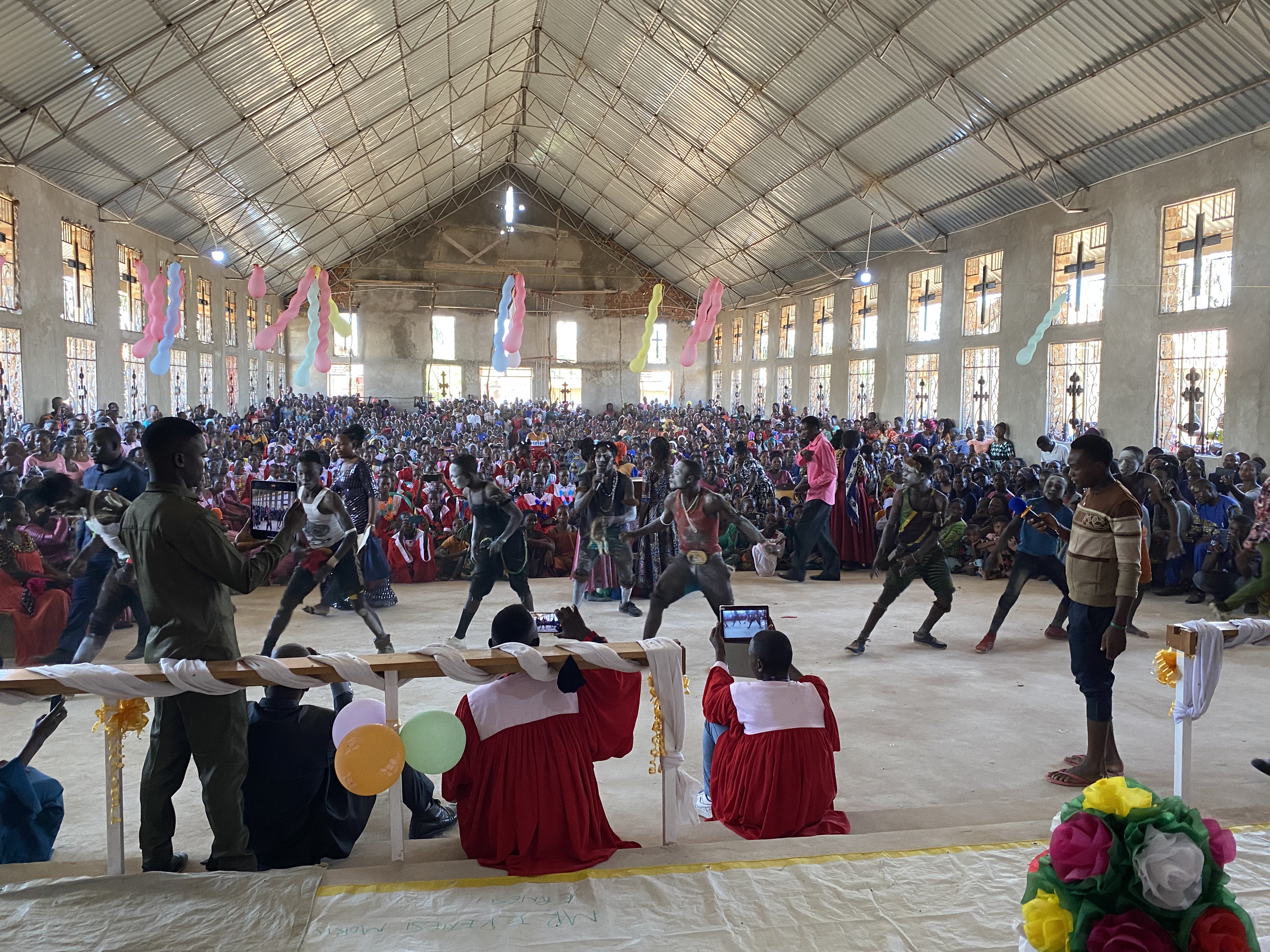
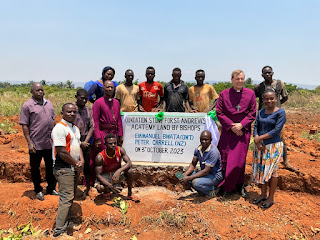
During those days we participated in nine confirmation services (me preaching at seven of the nine), one church opening service, visits to five other parishes, a visit to St. Andrew's School, Kasulu and an associated unveiling of a foundation stone at the new greenfields site for the school, visits to five churches each of which is being rebuilt as a larger church, and a visit to an orphanage. Along the way there were unveilings of foundation stones for two new vicarages and a church office. Teresa's count of the number of people I confirmed is 445 - nearly 900 confirmations between us two bishops. Most of the visits above involved travelling around the Diocese, a few were in Kasulu itself, the second largest city in the Diocese and the place where the Cathedral and Diocesan headquarters are located.


If that sounds busy - it was - nevertheless it was not burdensome - we never cooked a meal while in Tanzania, all travel within DWT was courtesy of the Bishop's Landcruiser and George, his full-time driver, and we had a spacious unit in which to stay when we were in Kasulu (7 out of 10 nights when we were in the Diocese).

To answer a question often asked since we came back: it was hot. Most days, the temperatures rose to between 30 and 35 degrees Celsius, but a few days - when in the highlands of the Diocese, up towards Burundi - the temperatures were between 20 and 25 degrees. The heat was made bearable, especially during long services inside church buildings, by sipping water frequently - courtesy of readily available bottled water.

Impressions

The strongest, most overwhelming and moving impression made on me during this visit was the growth of the churches in DWT. Services filled with people, especially young adults, teenagers, children and babies combined with seeing new, larger churches completed, nearly completed, or underway.

The contrast was clear with (say) my own Diocese of Christchurch which itself - as one reads and hears reports - is illustrative of most Western Anglicanism - some growth, somedecline, increasing average age of regular worshippers.

Church growth is possible in the 21st century - I have seen it with my own eyes!


Yet, even in the midst of this growth, it was intriguing to hear some similar concerns to ones here in Christchurch: where are the men? (It was quite observable that women were the majority of each congregation. And this is so, despite the clergy of DWT being exclusively male, and the membership of vestries being strongly, though not exclusively, male.) 

How do we hold our young people as they move into adulthood - out of education and into the wider world? Both questions are our questions here in Christchurch.

The concrete expression of munerical congregational growth in DWT was seeing the number of buildings being enlarged or replaced with larger churches or having been replaced with larger churches within the past decade. I was told that  age-old questions concerning "buildings" versus "people" are discussed in this diocese, but it seems that "buildings" prevail. Apart from the obvious advantage that buildings confer on a congregation (a dedicated space to meet in, a space protected from the elements in which to gather), it struck me that church buildings - often the largest buildings in villages also stand as a testimony to the living God. Note, incidentally, that often in villages there were three large church buildings: Anglican, Catholic, Pentecostal.


Large recent church beside smaller former church

Seeing church growth in a diocese such as DWT made a great impression, not only about growth in people at worship, in size of church buildings and in new church plants, but also in the self-confidence of the African church. Our experience was of an Anglican church which has the confidence of knowing it is growing, it is contributing to community cohesion, and it is controller of its own destiny. Projects such as church builds and a new school being built no doubt benefit through support from outside of Tanzania, but at no point were appeals made to us for assistance nor was there talk about any regular supply of such external support. The sense we had was that this diocese is full of generous givers committed to development for a better future.

But the impression of self-confidence was also of a church which despite its origins in British/European/Australasian missionary work, had moved a long way on from dependency on a far off mother church. This was a post-colonial church developing its own style, character and engagement with Tanzanian society and culture.

Insights

The cultural situations of Tanzania and New Zealand are very different in many ways, though we share a love of smartphones! From a church and gospel perspective I have come away from Tanzania with the realization that churches engage with the cultural hand they are dealt with, and no church is necessarily better at that engagement than another.

In my understanding the cultural hand dealt to the Anglican church in Tanzania - or, at least, in the Diocese of Western Tanganyika - is one in which natural population growth offers opportunity for churches to naturally grow as children are brought up in the faith. (On population growth generally in Africa, see this NYT article).

Further, compared to the material, social, sporting and outdoor opportunities available in a country such as NZ (i.e. plenty of things to do at the weekend rather than participate in church), it struck me that there were few attractive alternatives in Tanzania to being involved in church. (Arguably, this situation, broadly speaking, has similarities with NZ in the 1950s: a "baby boom", few alternative activities to church on Sunday mornings, churches at the centre of community activities including church-based sports teams, churches being built as housing expanded in new suburbs in our cities).

Thirdly, my sense out of various conversations, is that in Tanzania, the general cultural attitude to faith (Christian or Islam) is that this is a good and normal thing. (Compare to NZ culture where actual Christian commitment demonstrated by regular church involvement is often seen as a weird and strange thing.) That is, the cultural hand dealt to the Anglican church, indeed all churches in Tanzania, is a pretty good hand to be dealt with when aspiring to lead churches into growth.

Put in another way, here in Aotearoa New Zealand, we are working hard to be church and to share the gospel of Christ in a challenging cultural milieu, with many things against that work - a hardened post-Christian indifference to the gospel, alternative activities in life, lives which through good health and material benefits mostly have no urgency about engaging with spiritual realities. We may be tempted to despair when we work so hard for the Lord, but we can and should rejoice: we are doing the Lord's work in this particular time and place and culture. Meanwhile, in Tanzania, church workers also work hard and they are doing the Lord's work in their particular time and place and culture and we rejoice with them in the growth which is taking place.

Image

An image in my mind is that if culture is the sea and the church is a surfer with a surfboard then the wave of Western culture has crashed down on the Western church. As a result we are discombobulated, disrupted and distracted as we ask the question how can we get back on our surfboard and find again a wave to ride triumphantly.

By contrast, on this imagery, the Anglican church and other churches in Tanzania are riding the crest of a wonderful wave. May it never crash down on them!

Investment

I am very grateful for the support of the Church Property Trustees/Diocese of Christchurch in covering the expense of my return air tickets and other associated expenses of the trip. Air travel is not cheap these days - even when travelling economy - and the final thoughts here are my thoughts on the benefits of the visit to DWT for my ministry as Bishop in the Diocese of Christchurch.

In no particular order of priority:

- A general increase in breadth of experience and understanding of the role of bishop (I have not previously spent 11 days in the company of just one bishop!).

- A specific gain in understanding of African Anglicanism through a Tanzanian lens. African Anglicanism is both the majority Anglicanism in the globe today and the fastest growing part of global Anglicanism.

- I appreciated seeing with my own eyes the roles (i) culture and (ii) natural population growth are playing in the growth of Anglicanism in this part of the world.

- A particular insight into the role the Gafcon movement is playing in African Anglicanism: I learned that while GAFCON the conferene is appreciated, Gafcon the movement telling people whom they may or may not associate with in the Anglican Communion is not appreciated by all African Anglicans!

- In my own ministry, as a result of the visit I would like to review (or immediately change) the following aspects of ministry:

1. Joint visiting of ministers/parishes with the local Archdeacon.

2. Require specific ministry work to be undertaken in a parish by a person seeking ministry discernment. (For clarification: most people seeking discernment in our Diocese are working well on specific ministry tasks. )

3. Review how we give our monetary offerings during church services. (Without implying any specific change, I was taken by the active manner of giving in services in DWT, whereby each individual, including children, walked forward to place their offering in a collection basket/bowl.)

Finally, there is plenty to think about in respect of developing a relationship with DWT and/or another Tanzanian diocese, projects re education and parish ministry that might be supported, and an appropriate way or ways in which we might receive ministry here from DWT and/or another diocese.