Monday, October 31, 2022

Ways Forward: General Synod/Te Hinota Whanui 2022

The thing about Anglican synods is that we may spend time on the past (reports, accounts) and get stuck in details about the future (budgets, promises to take action on some issue of the day), but the real measure of a synod's significance, over the long term, is whether it offers a way or ways forward to a better future (formally through legislative change or resolutions, or informally through (say) the mood of participants, key appointments/elections to committees and boards).

So, last week we held our General Synod/Te Hinota Whanui in Nelson ...*

What happened? With the help of reports, of course, in Taonga, we can note:

The opening;

The Presidential Address;

The opening eucharist;

A  day of being informed/educated/formed (i.e. wānanga) about knowledge in Maori culture (mātauranga);

Debate and decisions about St. John's College;

As usual, something about our common prayer;

Appropriately, quite a bit of our conversation concerned the submissions to, recommendations to date of the Royal Commission on Abuse, and our responses to them;

It was a good occasion, of course, for meeting people. I met Dean Jay Ruka, a representative of the Diocese of Waikato and Taranaki, for instance, for the first time. Already familiar colleagues and friends were there as well - Bishop Justin Duckworth, for instance, is another member of General Synod/Te Hinota Whanui to have a recent article about his ministry! One special guest was Archbishop Philip Freier, Archbishop of Melbourne - Philip helped us out by chairing the key debate on St. John's College (due to our archbishops and other bishops being conflicted about various elements in the story of what has unfolded re changes to the governance of the College in the past year or so. Having gotten to know ++Philip during the recent Lambeth Conference it was lovely to spend time with him again.

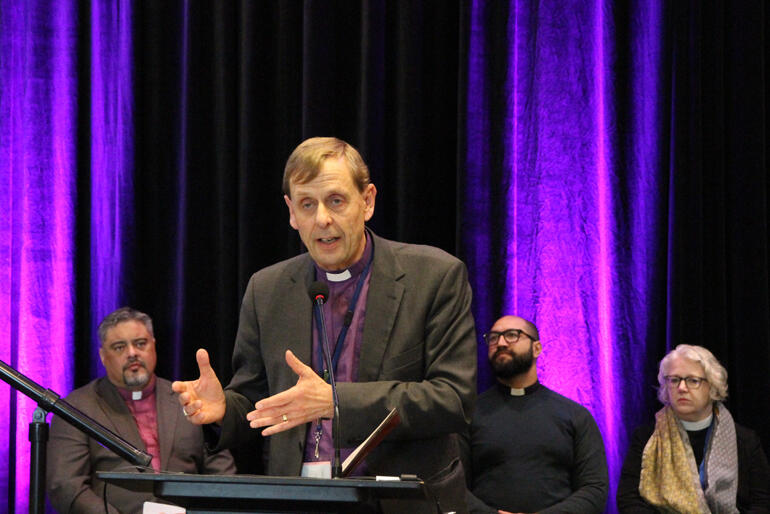
I have discovered there is a not too bad photo of me on the Taonga site :)


Back to the key question posed above: did our meeting together chart some ways forward for our church? Here are three ways forward:

1. Our wānanga day on mātauranga charted a way forward for our church to develop a deeper, wider, better understanding of Māori culture and within that culture, what matters and why it matters, how the world is understood and how the world is engaged with by Māori.

2. Our debate about St John's College opens the door for our church to finally cease a regular cycle of reviews of the College and to begin a period of stability and calm for the College through many years ahead.

3. Our recognition of the impact of the Royal Commission on Abuse offers the possibility of a new future as the safe church we should have been but have not been.

BUT: what was not charted as a way forward was engagement with the future of our church as a church in statistical decline while being a church with an amazing potential future (for example, as a church positioned for the future of our bicultural, multi-racial, multi-ethnic country).

I enjoyed this Synod. Despite some disagreements, we were in good spirits (marked, e.g. by some good humour) and it was noticeable that we kept talking to each other outside of the main sessions. Living with difference is key to visible, on the ground of this earth and this life, unity. I think we left Nelson for our home corners of God's vineyard in a good place.

*Incidentally, as we cycle through different hosts: Tikanga Pakeha (seven dioceses), Tikanga Maori (about every third synod), and Tikanga Polynesia (about every 10 - 12 years), it takes a while to return to a venue. The last time that General Synod/Te Hinota Whanui was held in Nelson was in 1994. I was not a member of the synod then but recall visiting it - I was then working in the Parish of Stoke, Nelson.

Monday, October 24, 2022

New Methodism-Brethrenism is True Anglicanism?

Continuing to reflect on the question of Anglican unity in a fractured world, divided global Christianity, net-torn Anglican Communion, I note, looking over my ecumenical shoulder, that there are amazing stirrings of difference and dissent within Roman Catholicism, spurring Pope Francis to remark with concern about polarization on the 60th anniversary of the beginning of the Second Vatican Council in 1962.

In this report by Christopher White, National Catholic Reporter (H/T Ron Smith), the opening paragraph could have applied to the Anglican Communion any time since 1998!

"Pope Francis on Oct. 11 marked the opening of the 60th anniversary of the Second Vatican Council — a three-year period that launched landmark reforms in the Catholic Church's relationship to the world around it and the church's own liturgy and practices — by pleading for the church to "overcome all polarization and preserve our communion.""

What to do with our own Anglican "polarizations" and attempts to "preserve our communion"?

Well, I've been thinking about two previous challenges to Anglican polity which, unfortunately, did not end in unity but in a division, with a twist, as I shall attempt to explain.

Those two divisions (or, perhaps better, separations) occurred as Methodism found itself unwelcome in the Church of England and then a century or so later as Plymouth Brethrenism was established. In both cases (seeking here to comment as objectively as possible) there was aspiration to develop church life freed of the then structures and protocols of Anglican ways and means of being church. 

But there was a notable twist: no longer were there bishops (at least not initially for the Methodists) nor communion with Canterbury. Nor, for that matter, was there any attempt (so far as I am aware) to continue with the word “Anglican” (or similar) in the naming of the new churches which resulted. Thus there was separation and no confusion about the nature of each new church (or set of churches).

Fast forward to today’s world. While there are similarities in concerns today, for a purer, more biblical, more faithful-to-Jesus church to be formed, the disaffiliation of members of Anglican Communion provinces today is leading to a confused state of global Anglicanism. 

First, churches (which includes CCAANZ hereabouts and the Diocese of the Southern Cross in Australia) are being formed which have bishops. Just this past weekend, in the polity known as AMiE, three new "bishops for Britain" were ordained in Hull. 

Secondly, the word “Anglican” often features in the new names of such entities. In turn this means there is claim and counter-claim about who the “true” or “legitimate” Anglicans are today, around the globe. There is, so to speak, a sharp question whether a new “21st century Methodism-Brethrenism” is the true Anglicanism?

Now, this is where things get a little (if not a lot) interesting because there is a degree of arguing past one another on the matter of true/false Anglicanism.

I am exploring certain questions here framed by “true” versus “false” but, mostly, I do not like making claims about true Anglicans and false Anglicans. My preference is that we simply talk about what it means to be Anglican and what we agree or disagree about this matter.

For instance, I want to argue that there is an historic, personal component to being Anglican which means that Anglicans are Christians in communion with the Archbishop of Canterbury.

But there are Anglicans in the world today who clearly disagree with me because they call themselves Anglicans when they are not in communion with the ABC.

On this line of argument, Anglicans hold to a set of beliefs (e.g., as expressed in the 39A and the BCP) and determine that communion with other Anglicans is based on sharing those beliefs rather than on a fellowship relationship with the ABC. Yes, such talk also involves considerations of polity: that Anglicans hold to certain beliefs-and-have bishops. And, with respect to “history” the claim here is that Anglicans today are in fellowship with Anglicans of yesterday because each generation shares the same beliefs.

I want to suggest that there is a bit more to the situation of 21st century Anglicanism and who may reasonably or legitimately claim to be "Anglican" than the above paragraphs. 

The point of our mother church, "the Church of England" is that it was "the Church of England." That church sought (and still seeks) to be a church of all England, both in the sense of potentially engaging with everyone in England and in the sense of reflecting a range of theological views (Catholic and Protestant, evangelical, broad and Anglo-Catholic, more recently, for and against the ordination of women). By implication, an Anglican church in the tradition of the Church of England, the 21st century CofE in the tradition of the CofE of previous centuries, is a church which is broad, inclusive, tolerant and intent on engaging all citizens of the nation.

Along the way of such intention, Anglican churches have adjusted ways of doing things and understandings of Scripture: women are being ordained, once they were not; artificial contraception was opposed by the Lambeth Conference in 1920 and then not so in 1930; remarriage after divorce is better accepted than it once was. Here in Aotearoa New Zealand we have restructured ourselves to better reflect the cultural diversity of our church for a bicultural nation and for a set of nations (we include, Fiji, Tonga and Samoa).

Of course such adjustments can be dismissed as some kind of sell out of the gospel to culture but they can also be robustly supported and advanced as the church understanding that the relationship between gospel and culture involves adjustments from time to time. Jesus spoke Aramaic but our four written gospels are in Greek. There was only one Jesus but we have four written gospels which are each shaped by different cultural contexts within which they were written and for which they were written and disseminated. On a matter such as divorce and remarriage, it is a simple fact that differences emerge between Luke/Mark, Matthew and 1 Corinthians. Under different circumstance, NT documents provide different responses to the power of the state (Romans 13 and Revelation 13). There is no one pristine, pure model of the first church replete with a set of infallible doctrines. This does not mean that 20 centuries later "anything goes" but it does mean that it is reasonable for Anglican churches to aspire to be either  a national church (CofE) or a church for the whole nation (many Anglican churches in many nations), that is, a church which is broad rather than narrow, inclusive rather than exclusive.

Consequently, alongside my argument that what matters in being Anglican is being in communion with the Archbishop of Canterbury, I also place the argument that being Anglican is being intentional about breadth and inclusivity of views and approaches to being Anglican.

Now, rather than jump up and down re (say) the latest development for AMiE in Britain as being "un Anglican" or similar, a more diplomatic conclusion to this post is, I suggest, to end with a question:

As we who say we are Anglican journey through the next decades of the 21st century, are we shaping ourselves to be a church which in its potentiality is for the whole nation or only for part thereof?

Sunday, October 16, 2022

They do things differently across the Ditch ... don't they?

This post is about "The Essendon Saga" - a story from Melbourne, Australia, featuring:

- an Aussie Rules football club, Essendon, which prides itself on its "inclusive" character.

- their need for a CEO.

- finding that CEO, Andrew Thorburn, a man with a distinguished track record as a CEO.

- some bright-eyed and bushy-tailed reporters digging into Thorburn's background and discovering that (1) he has a lay leadership role in a group of churches, City on a Hill,* and (2) a preacher at that church back in 2013 preached something considered objectionable by a majority of 2022's secular population.

- furore (not particularly focused on what Andrew Thorburn himself believes).

- Andrew Thorburn choosing to resign a day after being appointed but expressing regret that a Christian appears unwelcome in Australia's public space.

- quite a few views then being expressed about values, what Christians ought to believe, what Christians actually believe, whether people of faith are welcome in public life in Australia, etc --- see below.

- (We should note that on the views which were objected to a large number of Catholics, Muslims could be ousted from public life on the grounds of what a priest or imam preached in 2013!!).

-*City on a Hill is interesting in its own right as an Anglican-aligned group of churches.

MY THOUGHTS

Not much to add to what I have read but:

1. Not sure that our NZ cultural/political space is quite as vicious as Oz seems to be.

2. I worry that what happened to Andrew Thorburn happens because he is not Catholic or Muslim, i.e. that Protestants/Pentecostals are easy pickings for a media intent on finding fault(lines). Is it fair to pick on one group and not others?

3. Dan Andrews, Victoria's premier, is, at least to a degree, an illustration of 2. He is Catholic and sends his children to Catholic schools. Catholic teaching has not changed one iota on the matters which deconstructed Thorburn's brief tenure as CEO. Yet he can adroitly distance himself from the church to which he professes allegiance by claiming "my Catholicism" is not like ... whatever he doesn't agree with.

4. I really admire Archbishops Freier and Comensoli for standing up for the right to be Christian, including "Christian" meaning: having beliefs not all agree with, and to have a place in public life. If you like, their Christianity is my Christianity in a way that Dan Andrews' Christianity is not.


LINKS

A view here

A report here

Michael Bird here.

Archbishop Philip Freier statement tweeted here.

Archbishop Peter Comensoli has also put out a statement here.

Dan Andrews, Premier of the state of Victoria has spoken here about "my Catholicism."

Another view here.

Sunday, October 9, 2022

Further thoughts - good thoughts - on Lambeth 2022 and the continuing Anglican Communion

Bishop Christopher Cocksworth, Bishop of Coventry, writes about Lambeth 2022 (having been to Lambeth 2008) here.

Catherine Fox (among several notable roles in life is a bishop's spouse and was also at Lambeth 2022) writes about Lambeth 2022 here as part of her "Diary" for a recent Church Times.

+Christopher writes this about the overall sense of the conference as a significant moment in the history of the Anglican Communion, albeit from an episcopal perspective:

"As well as being taken deeper into what it means to be a bishop in the Church of God, I also learned more of what the Lambeth Conference means to the life of the Anglican Communion. Essentially, the Church is relational. The Conference was that part of the Church manifested as the Anglican Communion being the Communion — or, rather, becoming more fully the Communion, because our being is always in the process of becoming. I saw more clearly how the relationality of the Communion involves relationship with the physical space of Canterbury Cathedral (as some sort of maternal home, awesome in its proportions and history); with the actual person of the Archbishop of Canterbury (as a generous and loving host, gifted in this case with an extraordinary energy); with each other (as called and sent by God to our people and places, gathered together now in this place and with this person for the building up of our common life); with brothers and sisters from other churches and communions (whose fellowship and wisdom beckoned us beyond ourselves into a bigger vision of the church); with Jesus Christ, in the Spirit, and his relationship with the Father (greatly helped by some wonderful liturgies and inspired music)."

He also has some critiques to offer, one of which is expressed thus:

"What the Conference was not so good at was enabling the proper episcopal oversight and leadership of the Communion that, at least until 2008, belonged to the character if not necessarily the constitution of the Lambeth Conference. That incapacity showed itself in the process for drafting, refining, and affirming the Lambeth Calls. We were presented with immature texts. I do not mean that they were of poor quality (though some were certainly better than others); rather that they had not been through the sort of maturation process that such agreed statements require. There was certainly no credible process for developing them during the Conference, and the appeal to a third stage of the Conference after the residential period felt like a missed opportunity.

It may well be that, given the size of the Communion and the constraints of time and language on the Conference itself, the Lambeth Conference cannot be expected to fulfill both the relational-educational role and the discussing, deliberating, deciding function that belongs to the ministry of bishops if they are to be used by God to form the church (again in the words of the Church of England Ordinal) “into a single communion of faith and love.” I hope that work is beginning now on a new structure and shape of the Lambeth Conference that allows both roles to be fulfilled."

Catherine writes this about the mood at the end of the conference:

"I wished, fleetingly, that I’d applied for a press pass as a reporter on the Lindfordshire Chronicle. But I was there in good faith, minus any ironic shield, experiencing everything raw. At times, this hurt. What I sensed by the end was not (as the BBC reported) an “air of self-congratulation” that we’d managed not to split the Communion in half. It felt more like being tipped out of the wash cycle into a wholly new landscape, beyond a preoccupation with being right. Being right necessitates others’ being wrong. This new space gestured towards the possibility of our all being in the right, baptised into it, and raised up on the other side.

I’d say that everyone seemed almost stunned. Stunned and tender — in both senses of that word. We were bruised (stone-washed, blood-washed), and yet full of love for one another. Despite the screaming panic of gulls, maybe the wood pigeons get the final word."

To what Catherine Fox says about how we ended up, I simply say, Amen.

To what Christopher Cocksworth says I also say Amen about what he observes about the “relationality” of the Communion, both personal relationships and locational (historio-geographical) relationships.

To what he says by way of critique of the conference insofar as it engaged with issues and didn’t come to much in the way of decision-making, I say we should follow through and work on how we do make Communion-wide, Communion-authoritative decisions.

This might or might not involve an “old style” Lambeth Conference: all bishops together, for several weeks, synodically, methodically working towards decisions.

My own preference for exploration would be for regional decision-making conferences to work on matters and for a smaller “council” of primates, bishops, perhaps chancellors as well, to then convert the regional decisions into a Communion decision (perhaps subject to ratification by the whole Lambeth Conference or the, possible, Anglican Congress). ACC could figure in the mix also - perhaps proposing the matters that need decisions made.

There is a future for the Anglican Communion. It is a future for those who turn up to gatherings and not for those who do not. What is a question du jour is what gatherings best enable us to be what we want to be.

Finally, a voice from England, currently in Australia: the SMH has an article featuring an interview with the ABC here and this opening sentence:

"The Archbishop of Canterbury says a schism in Australian Anglicanism is dangerous for the church because it looks to outsiders like any other institution that struggles to overcome differences."

Sunday, October 2, 2022

Fascinating exchange … exploring life in a neighbouring diocese

It is a wee bit cheeky to talk about the Diocese of Sydney as a "neighbouring" diocese to the Diocese of Christchurch, but our diocese includes a portion of the West Coast of the South Island, and from there is only a stretch of water between us and the east coast of the Diocese of Sydney!

If the concern of this blog most generally is Anglicanism then the more specific concern is Anglicanism "Down Under" and that region of the planet refers to both New Zealand and Australia.

Within Down Under, for better or for worse, depending on where one sits geographically and/or theologically, the Diocese of Sydney is a "player". It is highly, numerically influential in the Anglican Church of Australia, it has played a significant role in the history and present of the Anglican Church in Aotearoa, New Zealand and Polynesia (noting, e.g., three Bishops of Nelson in succession in the 20th century drawn from the ranks of Sydney clergy, and the influential role in the 2018 disaffiliation from ACANZP of a number of congregations), and it is critical to the life of GAFCON.

In this year, 2022, the Diocese of Sydney is asserting its influence as the Australian Anglican church works on its understanding of marriage and blessings of civil marriages. Where the assertion of that influence ends is a matter of concern to many Australian and New Zealand Anglicans, not least becasue Sydney has lent its support to the creation of a new Diocese of the Southern Cross.

Enough from me by way of setting the scene for noting a fascinating exchange of views on Sydney Anglicanism by Martyn Percy (an English visitor to Sydney) and John Sandeman (a local participant in the Diocese of Sydney, and sometimes commenter here at ADU).

Percy has written "Deconstructing Sydney Anglicanism: Past, Present and Futures: A Tetralogy" which can be read here.

Sandeman has responded with two posts on his blog The Other Cheek. First, "Martyn Percy takes on Sydney Anglicanism", then, "More Sydney Anglican Criticism, and a Response". In the first post he makes an acute observation, 

"[Percy's] piece is curiously fuzzy at points and sharply accurate at others."

There is also a related exchange in the comments to a Thinking Anglicans post (but they are inter alia among some 90 comments when I originally drafted this post).

There is much to ponder in the paper and in the response (and much to appreciate about the respectful conversation they conduct between themselves).

The following are simply some things which strike me - by no means are they a guided tour of the main points or the deepest insights to be found in the exchange.

1. Percy reports this hitherto unknown dissension in the ranks of Sydney young adults:

"For example, the largest university church in the city (St. Barnabas Broadway) saw the students threaten revolt and secession over the stance of the Diocese on same-sex unions. They compelled the Rector to make their views known, and he (reluctantly?) obliged."

2. A Percy description of reading the Bible is a moment to think about how evangelicals read the Bible around the world, not just in Sydney:

"the attitude to scripture that is a form of pseudo-science.  Or, is perhaps better understood as a specific mode of congregational engineering. The Bible is read as a ‘manual’, and applied to the breakdowns, repairs and maintenance in the life of a Christian. Thus, if facing the prospect of a divorce (family or friend), you may hear “turn to chapter X and verse Y of Book Z” as the answer and the means of resolution. The Bible is therefore akin to some car-repair manual."

Relatedly, there is also a challenge to all evangelicals about how we understand the authority of the Bible in its parts as well as in its whole:

"Treating scripture as one equivalent text, in which every single chapter and verse is equally authoritative, is a bizarre approach to the Bible, and not one that it ever asks of its readers.  The Bible has no self-conscious identity – the title of this scared book being applied long, long after its (disputed) component parts were assembled and broadly agreed.  (Though please note, ‘broadly’, not definitively).  Treating each verse of scripture as comparatively, equally and absolutely authoritative is a strange approach to take to texts that are variegated in origin, genre and intention."

3. Percy almost makes a point but doesn't quite - let me attempt to explain. He notes in several places sentiments such as, 

"To understand Sydney Anglicanism, one needs to appreciate its similarities to the Exclusive Brethren.

Alternatively, he speaks along these lines, 

"Sydney Anglicanism is sectarian, for sure. But the roots of this stem from antagonisms locked into early Irish Brethren secession, and a complex spaghetti of class-related issues.

That not quite made point is this: whatever the roots of Sydney Anglicanism as we experience it today (Irish Protestantism, history of marriages between Anglicans and Brethren, etc, as outlined by him), there are exclusionary if not sectarian ways in which Sydney Anglicanism acts.

We see such acts in the support it gives to GAFCON (i.e. to member provinces of GAFCON which have more or less formally seceded from provinces of the Anglican Communion or directly from the Anglican Communion), and now, in 2022, to the formation of a new Diocese of the Southern Cross.

We also see such acts in the unwillingness to accept a female presbyter or bishop from outside the Diocese of Sydney as having the status of presbyter or bishop inside the Diocese. 

Conversely, the Diocese of Sydney struggles to understand that the church could be broad (a both/and church) rather than narrow (an either/or church): cue the previous Archbishop of Sydney's urging those who wished to see change re marriage to leave the Anglican Church of Australia. Asking people to leave the church over disagreement is something the Exclusive Brethren do! A sect cannot cope with multiple views on a matter deemed critical to the identity of the sect.

The current Archbishop of Canterbury, Justin Welby, is about to tour Australia. He will visit at least one ministry in Sydney city. Will there be a formal meeting between the Archbishop of Sydney and the Archbishop of Canterbury? [UPDATE: 9 October. I see some Tweets which say there are at least two or three events for the ABC in Sydney, and a dinner with the Archbishop of Sydney.]

In some ways the exchange between Percy and Sandeman is a discussion of how things are within Sydney and raises the question whether all critiques of the actual reality of Sydney Anglican church life made by Percy are valid. 

My elucidation of Percy's not quite made point offers consideration of how things are when Sydney faces outside of itself: to the wider Australian Anglican church and to the Anglican Communion as a whole.

We can genuinely wish Sydney Anglicanism well as it engages in ministry and mission with the people of Sydney. Sandeman helpfully sets out challenging realities of being a gospel church in a growing, diversifying city.

We can also reasonably worry about Sydney Anglicanism's engagement with Anglicans outside of itself. if such engagement is driven by exclusionary, sectarian characteristics then is it an "Anglican" engagement with Anglicans?

If Sydney is an exclusionary sect, and it continues to seek for the Australian Anglican church to be remade in the image of Sydney, it is not possible to see this having a happy, peaceful, unitary ending.


Monday, September 26, 2022

Thanksgiving for our Late Queen

A pause in the continuing posts about aspects of current Anglicanism ... back next week with a fascinating set of to and fro re ... our neighbouring diocese!

So, our Queen - the Sovereign of New Zealand as well as of the United Kingdom - died on 9 September 2022. Today (Monday 26 September) we have a national memorial service at 2 pm in Wellington Cathedral. Yesterday, at 5 pm we had a Christchurch civic thanksgiving service, well reported in our local paper here.

The full text of my sermon is reproduced here:

Sermon on the Occasion of the Christchurch Civic Service of Thanksgiving for the Late Queen Elizabeth (25 September 2022)

READINGS: Psalm 23; Ecclesiastes 3:1-14; John 10:11-16

Opening Prayer:

Gracious God, may we this night be illuminated by the light of the same Christ who our Late Queen Elizabeth followed so faithfully. Amen.

Introduction:

I never met the Queen, so I was somewhat surprised on the morning her death was announced and in subsequent days to find myself in a state of grief.

Something was lost from my life and I had not expected to grieved by that loss.

As best I can tell, I have not been alone in this experience.

Since Queen Elizabeth died, 16 days ago, many, many things have been written and said about her.

Some of what has been articulated helps us make sense of the experience of grieving for the loss of someone we may never have met.

For example, Ben Okri, British poet and novelist, writing inthe Guardian, said,

“[Queen Elizabeth II] hovers there in the halfway world of dream. A long constant presence in the life of a people has that effect. Her iconography has penetrated the subconscious of the land and many lands. It is perhaps why she felt at once so forbidding, so familiar and so intimate, as if in beholding her you encounter something more than a person or a monarch. It may be one of the greatest secrets of royalty, that they have made themselves, through the intimate art of portraiture, into figures so familiar that they seem to be a part of the furniture of your psyche. And yet they are so remote.

Ben is putting his insightful finger on something in that paragraph: a remote person who is nevertheless familiar, a long constant presence in the life of people, someone whose penetration of our subconscious means we feel we knew her, and she knew us.

Our grief is all too real because the mystery of monarchy is that we feel the Queen has shared our lives with intimacy and familiarity, and now the lives we live are diminished by her departure in death.

Thanksgiving

Tonight, we are gathered here in Christchurch not only to mourn the loss of our Queen, but also to give thanks for the life she has lived and the conduct of her rule as our Sovereign.

To slightly rephrase something from our Ecclesiastes reading, this is both a “time to mourn” and also a “time to heal” by focusing thankfully on all that has blessed us through the Queen’s reign.

As we give thanks for the Queen’s life and rule, we also remember with appreciation her visits to our city and to our region.

Perhaps the happiest of her ten visits to our city and region was the 1974 visit when the Queen and Duke of Edinburgh, Prince Charles and Princess Anne were here for the Commonwealth Games.

I suggest we can thank God for three characteristics of the Queen’s life and reign:

Service before self

There was never any question with the Queen that she put service before self. Her adult life was committed, from a public broadcast when she was just 21 and not yet Queen, to the service of the realms over which she was destined to be Sovereign.

Amazingly, it turned out that the Queen died only a short while after performing one last act of service for the United Kingdom, at the age of 96, ushering in a new Prime Minister, Liz Truss.

She was working to the end, service being placed before self. For that we give thanks.

Words Archbishop Justin Welby said at the Queen’s funeral last Monday bear repeating as we reflect on the Queen’s service as a kind and benevolent leader:

People of loving service are rare in any walk of life. Leaders of loving service are still rarer. But in all cases those who serve will be loved and remembered when those who cling to power and privileges are long forgotten.

A second outstanding reason for giving thanks to God for the Queen is this: the Queen exhibited

Faithful duty grounded in faith


++Stephen Cottrell, Archbishop of York said this in a sermon two days after the Queen died:


“And where did this come from? This way of being a monarch that was more about service than rule?


At her Coronation, …, in perhaps one of the most poignant moments of the service, she steadfastly walked past the throne upon which she would sit and knelt at the altar, giving her allegiance to God before anyone else gave their allegiance to her.”


This sense of the faithful duty of the Queen being grounded in faith in Jesus Christ is further probed by ++Rowan Williams, when he recently wrote about that part of the coronation service in which the Queen was anointedwith oil by the then Archbishop of Canterbury:

And this is what the royal anointing means at its most important level—a gift of the Holy Spirit to hold a fragile human person in faithfulness to this place where community can gather for restoration and renewal. There is no doubt at all that this was exactly what Queen Elizabeth believed about her role. It was a vocation for which she had been blessed and graced, and the anointing was at the heart of it.

Whatever we make of the role Christian faith played in the life of the Queen,

whether we personally identify with that faith or simply acknowledge and respect it, as many religious leaders of other faiths have done,

we can be thankful that the duties performed faithfully by the Queen, every day of her reign, flowed out of a deep conviction that hers was a divine calling and that she was accountable to God for how she fulfilled that calling.

Finally, we can also be thankful for the Queen’s

Aura imbued with aroha.

In an age of celebrity, the Queen was the greatest celebrity of them all.

There was an aura to the Queen which set her apart, not only from us ordinary people but even from the anointed kings and queens of popular culture.

Yet the Queen’s aura, her ability to inspire everyone’s respect and devotion, and to make even celebrities nervous about meeting her, was imbued with aroha, with love.

Perhaps only the Pope and the Dalai Lama express within our contemporary culture a similar sense of an aura imbued with aroha.

For the Queen, as she increasingly made clear through her annual Christmas broadcasts, that aroha, that love for her people was a love flowing from the very heart of God.

The Queen knew who her good shepherd was, and like the good shepherd she sought to care for her people.

For her aura imbued with aroha, we also give thanks to God.

Conclusion:

In conclusion, using apt words from ++Justin Welby’s funeral sermon,

Christ rose from the dead and offers life to all, abundant life now and life with God in eternity. …

We will all face the merciful judgement of God: we can all share the Queen’s hope which in life and death inspired her servant leadership.

Service in life, hope in death. All who follow the Queen’s example, and inspiration of trust and faith in God, can with her say: “We will meet again.”

Monday, September 19, 2022

Clearly Scripture is not as clear as clearly many would like it to be!

How clear is Scripture on matters of importance to its readers?

More technically, is Scripture "perspicuous"?

Is Scripture clear/perspicuous on some matters and not on others?

Is Scripture clear on a matter in one generation but not in another?

Lee Gatiss, Director of the Church Society, has recently spoken critically of Lambeth 2022 and some things Archbishop Welby said during it.

A text version is here and a video version is there.

Essentially, his critique of Welby is this (my bold):

"That was the issue at hand as he spoke: can we bless same-sex marriage, or not? And rather than clearly identify the glaringly obvious deviation from historic Christian orthodoxy, he spoke very highly of those who deny the truth: their “long prayer” and “deep study” and their view of scripture and of Christ. Those who would have been seen as heretics by every previous generation of Christians across the world were invited and treated as brothers and sisters in full communion."

Or, Scripture is completely clear on blessing same-sex marriage (i.e. Scripture says No), those who think otherwise are clearly heretics. Ergo, the ABC is wrong not to exclude churches which either do not think Scripture is clear on this matter, or may think Scripture is clear that the answer is Yes.

Now, you could probably predict where I might want to go on this: Scripture is not actually clear on such blessings (because it does not address the particularity of our age). Actually, that would be to go down a pathway often gone down here. No further need!

Let's go in a slightly different direction and focus on the general question of the clarity/perspicuity, or otherwise of Scripture.

Let's assume, by the way, that Scripture is clear on matters of salvation.

Is Scripture unclear on other matters?

I've been recently thinking that there has been and is something of a challenge re the clarity or perspicuity of Scripture when we shift from reading Scripture about our relationship with God and read Scripture about our relationships with each other, about our human experience of relationality.

Take the relationship between humans known as slavery. Good Christians argued for and against the keeping of slaves in days gone by. Fair enough in many ways because no text in Scripture unambiguously says, Stop keeping slaves. Put in other words, Scripture is clearly not against slavery but arguably unclear whether it is in favour of slavery or simply in favour of making the best of a systemic feature of ancient economies. Most NT texts speaking about slavery focus on masters treating slaves well and slaves impressing their masters with their virtuous and diligent service. That now Christians are very clear that we should not keep slaves, that there should be no slavery anywhere is not a triumph of the perspicuity of Scripture! 

(Ironically, we might also note that the nearest we come to Scriptural clarity about employers/employees is to read the texts on masters/slaves and make appropriate translation to modern working conditions. We make that shift in relating Scripture to modern life. Do we do so on other matters?)

We could then look at marriage and divorce. A rough trajectory through Scripture is that marriage is permanent (Genesis 2) but reasons for divorce press on the making of Israel's laws (other books in the Torah) and divorce is permitted in some circumstances. Through subsequent centuries discussion about divorce continues and by the time of Jesus two schools of rabbinic thought debate with each other, one "hard" and one "soft" on the matter. When Jesus is asked about divorce, our best take is that he sides with the "hard" school and either (in his original response) gives no grounds for divorce or only one ground (adultery). Yet Matthew's Gospel in chapter 19 provides a so-called Matthean Exception and Paul in 1 Corinthians 7 provides a so-called Pauline Exception so there are signs that the earliest church faced questions (as Moses did) and came up with some variation to what the Lord had laid down. Fast forward to the 20th and 21st centuries, and we see further variations being worked out through time in the main Christians traditions, none of which is clearly taught by Scripture. No annulment process is laid down in Scripture for Roman Catholics, no variations in the character of weddings for second or even third marriages is set out Scripturally for Eastern Orthodox, and Protestantism has engaged with questions unknown to Scripture such as a wife leaving and divorcing an abusive husband.

Incidentally, each such main Christian approach is reasonable on the basis of seeking to match Scripture with life, and each such approach develops a tradition of interpretation of Scripture and yet Scripture as "supreme authority" cannot readily dislodge where each church has gotten to on these matters because the reasonable, traditional response developed has precisely evolved from finding Scripture to not offer a once and for all circumstances authoritative answer to human questions.

Next up is the relationship between women and men in the life of the church, a question partly discussed in relationship to the Christian family: the relationship between husband and wife; and partly discussed (in some churches) in relationship to the (im)possibility of ordination of women to positions of responsibility in the ordering of the church: deacon, priest/presbyter or bishop.

On the former we have faced the challenge of Ephesians 5:22 (and similar verses) and (unless otherwise belonging to a school of thought called "complementarianism") determined that this might not mean what it looks like it means, e.g. because it is governed by Ephesians 5:21. But doing this (which I do happen to do), does rather call into question the clarity with which (e.g.) Anglicans once held on the matter, expressed in the Book of Common Prayer marriage service which asked the wife to be to declare that she would "obey" her husband, but asked of the husband to be to declare that he would "love" his wife.

On the latter we have faced the challenge of a variety between texts of Paul (or his Pauline imitator(s)), some of which seem to support women in leading roles (Romans 16, references elsewhere to Priscilla and Aquinas, a possibility in 1 Timothy 3 that women as deacons is supported, all in keeping with the genderlessness of Galatians 3:28 and the apostolicity of Mary in John 20) and some of which appear, in a similar spirit to Ephesians 5:22, to subjugate, even silence women to the authority and voice of men (1 Corinthians 11, 14; 1 Timothy 2). 

Possibly the school of thought known as complementarianism may have a virtue of consistency in believing Scripture is clear on this matter; but the overwhelming tendency in contemporary Christianity (Catholic, Eastern Orthodox, Prostestant, Pentecostal) is to explore, with a lesser or greater urgency re actual change, the possibilities for a new found recognition of the equality of women to men as both being fully human and fully alive and gifted in the Spirit of God. In some thinking among conservative evangelicals - I find - it is the apparent lack of clarity of Scripture on the matter which permits them to support the ordination of women. For some, this exploitable lack of clarity only extends to ordination to the diaconate; for others, it extends to presbyters or to presbyters and bishops.

This exploitation of lack of clarity on one matter only highlights the exploitation of clarity on other matters of humans relating to humans. Is there Scriptural clarity on the matter of how we interpret Scripture in favour of modern life when some texts are in tension with each other compared with when Scripture provides (or appears to provide) clarity?

Another matter of humans relating to humans concerns one human killing another human. Generally this is prohibited ("Do not kill"), through both Old and New Testaments, but exceptions happen and so debate occurs over those exceptions. Is war (which necessarily involves killing) such an exception? For some time in earliest Christian history, war was not an exception and Christians determined - with Scriptural clarity, with respect to the teaching of Jesus - they would not be soldiers. While a pacifist streak continues in Christianity, mostly we accept that sometimes war cannot be avoided and Christians will kill. For centuries Christians have presided over justice systems in which execution of criminals was accepted. Currently capital punishment is no longer possible in some jurisdictions in which Christianity has and may still provide a dominant religious influence on the framing of laws; but some strongly Christian jurisdictions, notably the USA make capital punishment an option. Such legal support for killing another human being seemed unquestionable as a clear outcome of (e.g.) Romans 13. Yet such clarity has not prevailed everywhere.

There has been and continues to be greater unity among Christians on the question of abortion, that is, on the question of not killing an unborn child. But, even on abortion, differences prevail on the question of whether access to abortion (whatever Christians think about abortion) should be a legal possibility for those who wish, for whatever reasons, to secure an abortion of their unborn child. Scripture is unclear on the degree to which being against killing means one should be against legal access to abortion (e.g. if one's support for access to legal abortion presupposes illegal abortions will be procured).

Conclusion

The approach I am taking above involves great clarity about Genesis 1:27-28. Men and women are made in the image of God, what does that mean for reading, interpreting and obeying Scripture in 2022?

I think it also involves questions of justice: what is fair and consistent treatment of another human being? Is an enslaved human being (no matter how well looked after) being treated fairly, given that an enslaved human being means another human being (i.e. the enslaver) is treated differently? Is it fair that men may speak out loud in church, but women should be silent? Or, that women, otherwise gifted and able to teach, may not teach because they are viewed as inherently untrustworthy relative to men?

Nevertheless, all said above is prolegomena to detailed, depth consideration of the issues I have referenced with just a paragraph or two above.

The argument above is pretty simple: that we should recognise that Scripture may not be as clear as we either think, or would like it to be, on matters involving humans relating to humans.

Whether this makes any difference to arguments on That Topic is the discussion! Even this week I have had engagement on Twitter with a leading English evangelical in which his thesis amounts to: Scripture is clear on That Topic, end of discussion; but not clear on the ordination of women, so we may so ordain. So, please don't assume that my "prolegomena" above settles anything on That Topic or another issue. 

But if my prolegomena prompts any reader to think again about Scripture's perspicuity in general, re human relationships, my post for this week's job is done!