Sunday, November 27, 2022

NZ churches sliding, sliding, in bewilderment, into irrelevancy?

My former and very brilliant church history professor (when at Knox Theological Hall in the mid 1980s), Peter Matheson, has written a stirring column for the Otago Daily Times. (H/T Anglican Taonga for notice of the article).

Its heading is "Churches Must Rise to the Challenges of the Modern World."

He begins with a description of our sad state:

"It's an interesting experience being a churchgoer these days. We’ve been nudged to the periphery of society and lost out in numbers and influence.

Countless revelations about sexual misconduct by clergy have shaken public confidence. The accumulation of negative publicity in very recent times has been remarkable: Dilworth School, Gloriavale, Destiny Church’s antics, Arise Church’s leadership woes. The list seems endless, the latest issue being Simon O’Connor lauding the US Supreme Court’s verdict on Roe v Wade.

To any neutral observer it might well seem that the Christian churches stand for utterly regressive social and gender policies and all too often for the scandalous abuse of power.

So it’s been quite a turnaround for us churchgoers. In my student days at Otago the churches were at the forefront of radical action. The first anti-nuclear march in Dunedin was largely church-led."

He ends with some helpful suggestions:

"When talking with my non-Christian friends I often pose the question: where are we to get our values as a post-Christian nation?

The celebration of Matariki highlights a welcome awareness of what matauranga (Maori knowledge) has to offer us. We cannot, however, expect Maoridom to offer solutions to all the problems created by Pakeha: the stubborn indifference of suburbia to environmental meltdown, the worrying addiction of young people to social media

Maybe we need to pause, and think again about the rich resources that the Christian tradition of spirituality, theology and creative action has to offer.

As compassion fatigue looms, the churches’ discipline of daily and communal prayer for others is a crucial corrective.

The tough challenge, for sure, to the churches is to get their house in order, to package their transcendent message to meet the needs of the world of today. Reformata reformanda!"

Can any NZ reader here (or overseas observer) disagree with the thrust of what Peter is saying here, that "We’ve been nudged to the periphery of society and lost out in numbers and influence"?

To the degree that we have been nudged (or, indeed, nudged ourselves) to the periphery of society, there are definitely elements of (i) we deserve it (because of our failings), and (ii) we are bewildered - on which I offer some reflection in the next paragraph - and some timeout at the periphery could be valuable for sorting ourselves out.

A bewildered NZ church?

When Peter Matheson recalls church leaders at the forefront of (e.g.) anti-nuclear marches, the church in NZ was a simpler network of churches than today: the classic mainstream Protestant denominations, the Catholic church and some fledgling Pentecostal churches. And there was some good organisation of most of these churches, through the National Council of Churches. Church leaders could speak up and, more or less, profess to speak for the NZ church of God. Today, the NZ church is a varied, diverse bunches of churches, including not only many more Pentecostal churches, but also variants of the classic denominations (e.g. alternative Anglican, Presbyterian, and Methodist churches). This makes it harder to say, "I the leader of church X speak for all churches when I say Y." Not least, this is so, because in the expanding array of churches in our nation, there has been a growth in the conservative character of the NZ church, so the chances are remote that where social or political change is desired by society as a whole, then the church here would see itself as at the vanguard of change rather than at the forefront of resistance to change. Notably, during the Covid years, churches here found themselves internally stricken with division over vaccination.

There is one issue on which, just possibly, we are open to taking a lead, resistance to climate change, but this is a big, complex issue, and, apart from general messages about how we ought to resist climate change, coming up with particular initiatives is proving bewilderingly difficult.

How might we rise again?

To be frank, I do not know. 

But I like, very much, Peter's final point. In a post-Christian society which emphasises the "Christian" character of our nation by many beautiful acts of compassion, churches still have something to contribute by way of our spiritual treasures so that compassion fatigue is relieved and new vigour is given to the values widely espoused across our communities.

We are not finished yet!

But we will need to work on our relevancy rather than assume it.


Monday, November 21, 2022

Apocalyptic Anglicanism in Advent?

I have noticed recently, in the run up to Advent, the odd grizzle or two on Anglican social media about the lectionary providing readings for Morning Prayer from Daniel and from Revelation: "It's a bit too much," is the gist of the grizzles.

Naturally that gets me thinking, perhaps you too, about the role of apocalyptic literature such as Daniel and Revelation in Christian life generally, in Anglican life particularly, and in the last days [that was a subtle joke] before Advent and during Advent itself when we are invited by various readings to think about "the End" and "the Second Coming."

Some Anglicans might think talk of the Second Coming is not very Anglican, more the concern of certain fundamentalists from a certain northern continent. In which case, let me remind you of the collect for the Third Sunday in Advent from the Book of Common Prayer:

O Lord Jesu Christ, who at they first coming didst send they messenger to prepare the way before thee; Grant that the ministers and stewards of they mysteries may likewise so prepare and make ready they way, by turning the hearts of the disobedient to the wisdom of the just, that at thy second coming to judge the world we may be found an acceptable people in thy sight, who livest and reignst with the Father and the Holy Spirit, ever one God, world without end. Amen.

OK, so may be Anglicans do not talk about the Second Coming with capital letters, but we do talk about the second coming of Christ!

Anyhoo, back to Daniel and Revelation.

I think it a very good idea that the lectionary exposes us to the full breadth of Scripture, from Genesis to, er, Revelation, and thus we are confronted with what the message or messages of Daniel, Revelation and all similar apocalyptic (i.e. revealing, disclosing, unveiling) literature in Scripture is or are.

Apocalyptic literature is literature of stress and duress. 

Israel (of Maccabean times, c. 167 BC) stressed by the invasion of Greece, draws on the memories of the duress experienced when Jerusalem was sacked (597/587 BC) and Judah went into exile in Babylon, and produces Daniel, a set of tales of a faithful Jew which include visions which give insight into the hidden powers of darkness which work through the imperial forces focused against God's holy people and reveal the stronger powers of God's angelic rulers in order to strengthen Judah's resolve to be faithful.

Revelation, composed at the end of the first century AD, draws heavily on Daniel (and to a lesser degree on Ezekiel, Zechariah and Isaiah), to update for the followers of Jesus under stress (primarily a threat of imminent persecution) the kind of insights Daniel provided: hidden behind the activities of Rome and its local supporters and henchman throughout the empire are satanic forces; powerful though they are, the angels of God and the spirits of God, and, most importantly, Jesus Christ the risen, exalted Word and Lamb of God have got them covered and are about to swipe them off the face of the earth.

So, point (1): We may grizzle at the apocalyptic overload of reading both Daniel and Revelation on the same morning for a week or two because we are unstressed, but in our day, there are plenty of Christians under stress, particularly the threat of persecution and the challenge of being faithful when threatened with violence and loss of livelihood. Let's read Daniel and Revelation in solidarity with them.

Apocalyptic literature is literature of resistance

Both Daniel and Revelation call out imperial powers - human attempts to orchestrate people to submit against their better judgement to the arbitrary ambitions of despots and tyrants - and show them up for what they are: expressions of evil, idolatries rebelling against the rule of the Creator and Redeemer God of Israel. In doing so, like all apocalyptic literature, they ask of their readers that they stand firm in their faith in God and thus resist the encroachment of the evil powers.

So, point 2: We read Daniel and Revelation as a double dose of fortifying resolution to be godly people who resist imperialism wherever we find it, and in whatever guise we find it in today's world.

Apocalyptic literature is literature of disruption

Both Daniel and Revelation (and material in the gospels and in the epistles) propose that history is not endless: the story of human life is coming to an end. History as a tale of people marrying and producing offspring who marry and produce offspring etcetera is denied by apocalyptic literature which tells us God will disrupt life as we know it and dramatically turn the tables on the forces of evil and rescue God's people from complete destruction and annihilation.

So, point 3: We read Daniel and Revelation as alternative narratives to the stories we generally tell ourselves about studying, embarking on a career, finding a life partner to marry and raise a family, wisely setting aside money for later life, for a long, active and happy retirement, all premised on dying in our sleep at a very grand old age. Tomorrow the world may end. Am I ready? Tomorrow the axe of oppression may fall on me and my congregation. Are we prepared? Tomorrow I may be thrown to the lions? Will that be the end or does God have another future in store? Disruption is a part of history. We should not be surprised when it comes.

Of course, in a world in which some of us are growing old steadily (I had my 60-something birthday the other day), there are plenty of possibilities for disruption, even when we are not living in Ukraine or Iran. North Korea is firing off practice missiles. The world economy could tank. Twitter may fall over. Climate change may disrupt life in ways not even imaginable after the disruptive storms, floods, and fires of the past few years.

To be honest, of all ways of being Christian, being Anglican is not the best way to be ready for disruption.

We do steady state complacency rather well! We have often been on the side of empires rather than resisting their growth and standing against their rapaciousness.

In the run up to and the run through Advent, how will we Anglicans read Daniel and Revelation and those gospel passages speaking of the End?

Not with grizzles, I hope.

Sunday, November 13, 2022

Lambeth 2022 wasn't a failure, was it?

Whether Lambeth 2022 was a failure or a success, on some definition of each, may or may not matter in the great scheme of God's plan for the unity of all things (Ephesian 1:9-10), but I am interested in the "lesser scheme" of God's work within that part of the Christian world described as "Anglican", and the contribution Lambeth 2022 may be judged - short, medium or long term - to have made to that work.

Thus in recent days my eyes have alighted on the following articles, some of which have only appeared in the past week.

+George Sumner  (TEC), writing back in August 2022, offers a nuanced, hopeful, Global South-oriented view of the Communion's future, and looks forward to Lambeth 2032.

Andrew Goddard (England), writing as recently as 9 November 2022, offers a significant, detailed critique of what was said at Lambeth 2022, principally by ++Welby, in relation to matters of dispute and decision-making for the Communion as a body variously filled with provincial autonomies and interdependence aspirations. He concludes, in the end, somewhat bleakly:

"Elements of the Archbishop’s contributions, particularly in his final address, give hope for some degree of continuity with the Communion’s historic self-understanding and vision. Other elements, however, raise a number of serious questions and concerns particularly concerning autonomy and subsidiarity. These apparently represent a major break with the received account of these key concepts. This then results in drawing dangerous implications for ordering the Communion’s life. If these features are embraced as the fruit of the Conference’s “intense ecclesiological development” or simply allowed to stand by default (rather than being subject to further scrutiny and refinement, such as that implicit in the Global South’s communiqué) then sadly Ephraim Radner will be proved right and we have just witnessed, despite all the good it has accomplished relationally, “The Last Lambeth Conference.”"

So, what did Ephraim Radner (Canada) make of Lambeth 2022 in the article Goddard references? Writing in First Things in October this year, Radner opens with this paragraph:

"July’s was probably the last recognizable assembly of the Lambeth Conference we shall see in this generation (and perhaps the next). No longer will “all” the bishops of the Anglican Communion gather, but only some, and only from some places. No longer will the deliberation of the Communion’s bishops give rise to common teaching on matters of doctrine and morals. No longer will Anglicans around the world see themselves as engaged in a common evangelical mission."

His analysis of the situation, borne along by his resolute view that the threads which we hold in common are devoid of any substantial common agreements, leads to this - frankly bizarre - estimation of the Communion's common theology and mission:

"To judge by the words of its most public leaders, the Anglican Communion has come to represent a progressive version of the works of mercy: addressing injustice, fighting corruption, combating climate change. The time has come to admit that works of mercy provide the only framework for the current Anglican vocation."

On the other hand, there is the Lambeth 2022 conference I actually attended which highlighted our common commitment to discipleship - to following Jesus as the giver of divine life and embodiment of divine love.

Back to Radner: his final paragraphs about the future of the Communion could be summed up by the word "bleak." 

Is there hope?

Thankfully +Joseph Wandera (Kenya) offers some hope for the Communion's future. Before we get to that expression of hope, I love the observation Wandera makes in this paragraph about a phenomenon I saw myself (and felt a bit guilty about not myself making videos for consumption back in my diocese):

"It was quite common during the breaks to see a number of bishops, especially from the West, rushing to set up in a corner and convey news of the conference back to their home dioceses, using their digital devices. At one point, I was invited by an American bishop to be interviewed for his home diocese. How was I to communicate the deliberations at Lambeth back home to my largely rural congregations, where our infrastructure is limited, and smart phones are a luxury they cannot afford?"

The crucial and critical observation Wandera brings to this post's set of articles is Lambeth 2022's failure to engage with damaging, longstanding issues in economic injustice (such as the crippling effects of national debts), not least because we First World bishops only superficially connected with Third World bishops. Fair point.

But Wandera's conclusion is hopeful that Lambeth conferences will continue and will learn from shortcomings of the past:

"The Christian story is woven around the event of the Incarnation, and so embodiment such as what we experienced at Lambeth was an experience of a lifetime. However, such embodiment ought to be extended to our communities in real ways if it is going to have impact.

There is need for a new orientation around Lambeth, making it more relational, and sustainable around our common issues.

Thankfully, we are all on a pilgrimage, and Lambeth remains a powerful reminder of our connectedness as followers of Jesus."

A specific transition to a new future for the conference proposed by Wandera would be for it to take place away from England, say, in Nairobi. Why not?

Lurking in all the articles linked to above is the question of "who" is actually in rather than out of the Communion. If we bewail the lack of communion for the Communion, what is the Communion that suffers this lack?

++Linda Nicholls (Canada) opines in an article that Nigeria, Rwanda and Uganda have effectively separated from the Communion by not turning up to Lambeth 2022. (Others quoted in the article take different views).

Interstingly, at this point in time we can reasonably ask an important question of the Anglican province with the most Anglicans and most bishops in it.

What is Nigeria up to? It's with GAFCON rather than with the Communion isn't it? Well, "you be the judge" after reading this report in which Nigeria is busy establishing a Nigerian Anglican church in North America which is not part of ACNA (the GAFCON-alternative to TEC and ACCanada) - a move which has led a Nigerian bishop in the States, with his Diocese, to choose alignment with ACNA and not with Nigeria.

In the ten years between now and 2032, assuming there will be a Lambeth conference that year, what changes to global Anglicanism will we see take place? 

Will a blogpost in 2031 be reflecting on how Nigeria's global aspirations for its ruthlessly pure form of Anglicanism relate to GAFCON's more conciliarity global aspirations for pure Anglicanism relate to the Anglican Communion's bold faith that 90% of all provinces are represented at Lambeth 2032?

If there is one thing missing from the most critical articles above, it is the failure to recognise that the Communion consists of 42 provinces and only three failed to have representative bishops show up.

Monday, November 7, 2022

Can we ever change anything of substance in the life of the church?

A question thrown up by English events of the past few days,* is represented in the contents of a tweet which I copy here:

"Bishop of Oxford says he no longer believes in the Church of England teaching which he took an oath to uphold and protect.

If he had any integrity he would therefore resign his position."

That is, the question this post is concerned with is: How might the teaching of the church change? 

When we who are officers of the church (i.e. those who sign up to the teaching of the church) begin to think that something could or should be different, are we bound to suppress those thoughts, or to resign? What is the process by which the church changes its minds on a matter if its official leaders are bound to express no thoughts out loud about the possibility of change?

In other words, it is absurd to equate a commitment to the teaching of the church with a resolve to never, ever question it.

Sure, there are better ways and means to raise questions than others (think of the bishops through the years who have publicly questioned the resurrection and caused dismay and despair in the pews), but when there are issues which involve significant differences among members, and big questions over the church's relationship to society, it is appropriate to raise questions and consider changes and revisions.

On the content of the tweet cited above, rigorously enforced since, say, 1559, we would not have women ordained as clergy, there would be no remarriage in churches of divorced persons, the Book of Common Prayer would not be revised into a new prayer book which captured changes in Anglican eucharistic theology, and, noting the anti-Papalism of the 39A, there would be no ARCIC conversations.

(A Roman Catholic - Thomas Moore? - might go further, and say, that is precisely why the English Reformation is both wrong and bad: clergy forsook their vows!).

In what way may we who vowed to uphold the teaching of the church also be permitted to review it, develop it or even change it?

Historians of theology here will recall the great irony that John Newman forsook his vows to uphold the CofE's doctrines by leaving it, only to then, as a Roman Catholic, begin a long influence of his new church via the notion of "development" of doctrine, an influence which, arguably, is behind (or underneath) present day turmoil in the Roman Catholic church.

Current English turmoil

Following immediately on the heels of the departure of CofE bishops from a meeting about their response to the CofE process called Living in Faith and Love, the Bishop of Oxford, Steven Croft last week wrote a response to recent deliberations within the CofE. (The actual book he has written is purchaseable etc rather than available for free view or download). See also these articles in Church Times: an extract from the book here and a report here.

I wonder if the key question in this new phase of debate in the CofE is this (in the extract linked to above):

"The more the Church commends the goods of permanent, stable, and faithful relationships for heterosexual people in marriage, the more difficult it becomes to justify denying those goods and blessings to people who happen to be homosexual."

Do the rejoinders actually tackle this question? That could be a question for the CofE and its debates!

Speaking of rejoinders, there is:

A prompt rejoinder by Ian Paul at Psephizo.

And another by Vaughan Roberts, a vicar in the city of Oxford (download his pdf from this link).

CEEC statement here.

Perhaps most helpful of all, Angela Tilby, inspired by John Milbank, on a needed third way.

Except, in response to Tilby-Milbank's "third way", a friend on Twitter has tweeted that "second class" is not for him.

If on Twitter, you may see various back and forth, some very supportive tweets, and some disagreeing strongly. Unfortunately, social media responses not seen by me include, according to a tweet I have seen, abusive, hateful responses to +Steven.

Any how, this post is not intended to be a further foray into argument, but a note that the mother church of our Communion is moving into a new phase in its own journey on these matters. 

Having waited for Lambeth 2022 to be concluded, the relatively united front of their bishops (i.e. to refrain from much comment, one way or another), has now moved to a phase in which bishops such as +Steven (and a few others who have signalled public agreeement) are voicing their views.

The CofE bishops are meeting again before Christmas, and there is a next session of their General Synod in February 2023. What change might be proposed? What might be agreed to?

Nothing less than the unity of the CofE is at stake, even as nothing less than a "better deal" for the gay members of the CofE is also at stake.

Watch this space. It is critical to the way in which the future of the Communion itself will be shaped.

please comment on the question at the beginning of this post and not on That Topic ... and please take great care about any ad hominen comments. They will not be published, even if they are 1% of an otherwise 99% fine comment. Am too busy to moderate otherwise.


Monday, October 31, 2022

Ways Forward: General Synod/Te Hinota Whanui 2022

The thing about Anglican synods is that we may spend time on the past (reports, accounts) and get stuck in details about the future (budgets, promises to take action on some issue of the day), but the real measure of a synod's significance, over the long term, is whether it offers a way or ways forward to a better future (formally through legislative change or resolutions, or informally through (say) the mood of participants, key appointments/elections to committees and boards).

So, last week we held our General Synod/Te Hinota Whanui in Nelson ...*

What happened? With the help of reports, of course, in Taonga, we can note:

The opening;

The Presidential Address;

The opening eucharist;

A  day of being informed/educated/formed (i.e. wānanga) about knowledge in Maori culture (mātauranga);

Debate and decisions about St. John's College;

As usual, something about our common prayer;

Appropriately, quite a bit of our conversation concerned the submissions to, recommendations to date of the Royal Commission on Abuse, and our responses to them;

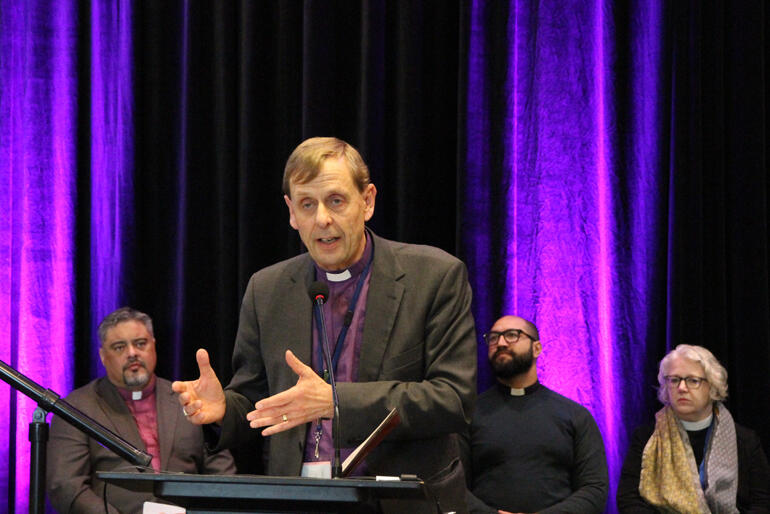
It was a good occasion, of course, for meeting people. I met Dean Jay Ruka, a representative of the Diocese of Waikato and Taranaki, for instance, for the first time. Already familiar colleagues and friends were there as well - Bishop Justin Duckworth, for instance, is another member of General Synod/Te Hinota Whanui to have a recent article about his ministry! One special guest was Archbishop Philip Freier, Archbishop of Melbourne - Philip helped us out by chairing the key debate on St. John's College (due to our archbishops and other bishops being conflicted about various elements in the story of what has unfolded re changes to the governance of the College in the past year or so. Having gotten to know ++Philip during the recent Lambeth Conference it was lovely to spend time with him again.

I have discovered there is a not too bad photo of me on the Taonga site :)


Back to the key question posed above: did our meeting together chart some ways forward for our church? Here are three ways forward:

1. Our wānanga day on mātauranga charted a way forward for our church to develop a deeper, wider, better understanding of Māori culture and within that culture, what matters and why it matters, how the world is understood and how the world is engaged with by Māori.

2. Our debate about St John's College opens the door for our church to finally cease a regular cycle of reviews of the College and to begin a period of stability and calm for the College through many years ahead.

3. Our recognition of the impact of the Royal Commission on Abuse offers the possibility of a new future as the safe church we should have been but have not been.

BUT: what was not charted as a way forward was engagement with the future of our church as a church in statistical decline while being a church with an amazing potential future (for example, as a church positioned for the future of our bicultural, multi-racial, multi-ethnic country).

I enjoyed this Synod. Despite some disagreements, we were in good spirits (marked, e.g. by some good humour) and it was noticeable that we kept talking to each other outside of the main sessions. Living with difference is key to visible, on the ground of this earth and this life, unity. I think we left Nelson for our home corners of God's vineyard in a good place.

*Incidentally, as we cycle through different hosts: Tikanga Pakeha (seven dioceses), Tikanga Maori (about every third synod), and Tikanga Polynesia (about every 10 - 12 years), it takes a while to return to a venue. The last time that General Synod/Te Hinota Whanui was held in Nelson was in 1994. I was not a member of the synod then but recall visiting it - I was then working in the Parish of Stoke, Nelson.

Monday, October 24, 2022

New Methodism-Brethrenism is True Anglicanism?

Continuing to reflect on the question of Anglican unity in a fractured world, divided global Christianity, net-torn Anglican Communion, I note, looking over my ecumenical shoulder, that there are amazing stirrings of difference and dissent within Roman Catholicism, spurring Pope Francis to remark with concern about polarization on the 60th anniversary of the beginning of the Second Vatican Council in 1962.

In this report by Christopher White, National Catholic Reporter (H/T Ron Smith), the opening paragraph could have applied to the Anglican Communion any time since 1998!

"Pope Francis on Oct. 11 marked the opening of the 60th anniversary of the Second Vatican Council — a three-year period that launched landmark reforms in the Catholic Church's relationship to the world around it and the church's own liturgy and practices — by pleading for the church to "overcome all polarization and preserve our communion.""

What to do with our own Anglican "polarizations" and attempts to "preserve our communion"?

Well, I've been thinking about two previous challenges to Anglican polity which, unfortunately, did not end in unity but in a division, with a twist, as I shall attempt to explain.

Those two divisions (or, perhaps better, separations) occurred as Methodism found itself unwelcome in the Church of England and then a century or so later as Plymouth Brethrenism was established. In both cases (seeking here to comment as objectively as possible) there was aspiration to develop church life freed of the then structures and protocols of Anglican ways and means of being church. 

But there was a notable twist: no longer were there bishops (at least not initially for the Methodists) nor communion with Canterbury. Nor, for that matter, was there any attempt (so far as I am aware) to continue with the word “Anglican” (or similar) in the naming of the new churches which resulted. Thus there was separation and no confusion about the nature of each new church (or set of churches).

Fast forward to today’s world. While there are similarities in concerns today, for a purer, more biblical, more faithful-to-Jesus church to be formed, the disaffiliation of members of Anglican Communion provinces today is leading to a confused state of global Anglicanism. 

First, churches (which includes CCAANZ hereabouts and the Diocese of the Southern Cross in Australia) are being formed which have bishops. Just this past weekend, in the polity known as AMiE, three new "bishops for Britain" were ordained in Hull. 

Secondly, the word “Anglican” often features in the new names of such entities. In turn this means there is claim and counter-claim about who the “true” or “legitimate” Anglicans are today, around the globe. There is, so to speak, a sharp question whether a new “21st century Methodism-Brethrenism” is the true Anglicanism?

Now, this is where things get a little (if not a lot) interesting because there is a degree of arguing past one another on the matter of true/false Anglicanism.

I am exploring certain questions here framed by “true” versus “false” but, mostly, I do not like making claims about true Anglicans and false Anglicans. My preference is that we simply talk about what it means to be Anglican and what we agree or disagree about this matter.

For instance, I want to argue that there is an historic, personal component to being Anglican which means that Anglicans are Christians in communion with the Archbishop of Canterbury.

But there are Anglicans in the world today who clearly disagree with me because they call themselves Anglicans when they are not in communion with the ABC.

On this line of argument, Anglicans hold to a set of beliefs (e.g., as expressed in the 39A and the BCP) and determine that communion with other Anglicans is based on sharing those beliefs rather than on a fellowship relationship with the ABC. Yes, such talk also involves considerations of polity: that Anglicans hold to certain beliefs-and-have bishops. And, with respect to “history” the claim here is that Anglicans today are in fellowship with Anglicans of yesterday because each generation shares the same beliefs.

I want to suggest that there is a bit more to the situation of 21st century Anglicanism and who may reasonably or legitimately claim to be "Anglican" than the above paragraphs. 

The point of our mother church, "the Church of England" is that it was "the Church of England." That church sought (and still seeks) to be a church of all England, both in the sense of potentially engaging with everyone in England and in the sense of reflecting a range of theological views (Catholic and Protestant, evangelical, broad and Anglo-Catholic, more recently, for and against the ordination of women). By implication, an Anglican church in the tradition of the Church of England, the 21st century CofE in the tradition of the CofE of previous centuries, is a church which is broad, inclusive, tolerant and intent on engaging all citizens of the nation.

Along the way of such intention, Anglican churches have adjusted ways of doing things and understandings of Scripture: women are being ordained, once they were not; artificial contraception was opposed by the Lambeth Conference in 1920 and then not so in 1930; remarriage after divorce is better accepted than it once was. Here in Aotearoa New Zealand we have restructured ourselves to better reflect the cultural diversity of our church for a bicultural nation and for a set of nations (we include, Fiji, Tonga and Samoa).

Of course such adjustments can be dismissed as some kind of sell out of the gospel to culture but they can also be robustly supported and advanced as the church understanding that the relationship between gospel and culture involves adjustments from time to time. Jesus spoke Aramaic but our four written gospels are in Greek. There was only one Jesus but we have four written gospels which are each shaped by different cultural contexts within which they were written and for which they were written and disseminated. On a matter such as divorce and remarriage, it is a simple fact that differences emerge between Luke/Mark, Matthew and 1 Corinthians. Under different circumstance, NT documents provide different responses to the power of the state (Romans 13 and Revelation 13). There is no one pristine, pure model of the first church replete with a set of infallible doctrines. This does not mean that 20 centuries later "anything goes" but it does mean that it is reasonable for Anglican churches to aspire to be either  a national church (CofE) or a church for the whole nation (many Anglican churches in many nations), that is, a church which is broad rather than narrow, inclusive rather than exclusive.

Consequently, alongside my argument that what matters in being Anglican is being in communion with the Archbishop of Canterbury, I also place the argument that being Anglican is being intentional about breadth and inclusivity of views and approaches to being Anglican.

Now, rather than jump up and down re (say) the latest development for AMiE in Britain as being "un Anglican" or similar, a more diplomatic conclusion to this post is, I suggest, to end with a question:

As we who say we are Anglican journey through the next decades of the 21st century, are we shaping ourselves to be a church which in its potentiality is for the whole nation or only for part thereof?

Sunday, October 16, 2022

They do things differently across the Ditch ... don't they?

This post is about "The Essendon Saga" - a story from Melbourne, Australia, featuring:

- an Aussie Rules football club, Essendon, which prides itself on its "inclusive" character.

- their need for a CEO.

- finding that CEO, Andrew Thorburn, a man with a distinguished track record as a CEO.

- some bright-eyed and bushy-tailed reporters digging into Thorburn's background and discovering that (1) he has a lay leadership role in a group of churches, City on a Hill,* and (2) a preacher at that church back in 2013 preached something considered objectionable by a majority of 2022's secular population.

- furore (not particularly focused on what Andrew Thorburn himself believes).

- Andrew Thorburn choosing to resign a day after being appointed but expressing regret that a Christian appears unwelcome in Australia's public space.

- quite a few views then being expressed about values, what Christians ought to believe, what Christians actually believe, whether people of faith are welcome in public life in Australia, etc --- see below.

- (We should note that on the views which were objected to a large number of Catholics, Muslims could be ousted from public life on the grounds of what a priest or imam preached in 2013!!).

-*City on a Hill is interesting in its own right as an Anglican-aligned group of churches.

MY THOUGHTS

Not much to add to what I have read but:

1. Not sure that our NZ cultural/political space is quite as vicious as Oz seems to be.

2. I worry that what happened to Andrew Thorburn happens because he is not Catholic or Muslim, i.e. that Protestants/Pentecostals are easy pickings for a media intent on finding fault(lines). Is it fair to pick on one group and not others?

3. Dan Andrews, Victoria's premier, is, at least to a degree, an illustration of 2. He is Catholic and sends his children to Catholic schools. Catholic teaching has not changed one iota on the matters which deconstructed Thorburn's brief tenure as CEO. Yet he can adroitly distance himself from the church to which he professes allegiance by claiming "my Catholicism" is not like ... whatever he doesn't agree with.

4. I really admire Archbishops Freier and Comensoli for standing up for the right to be Christian, including "Christian" meaning: having beliefs not all agree with, and to have a place in public life. If you like, their Christianity is my Christianity in a way that Dan Andrews' Christianity is not.


LINKS

A view here

A report here

Michael Bird here.

Archbishop Philip Freier statement tweeted here.

Archbishop Peter Comensoli has also put out a statement here.

Dan Andrews, Premier of the state of Victoria has spoken here about "my Catholicism."

Another view here.